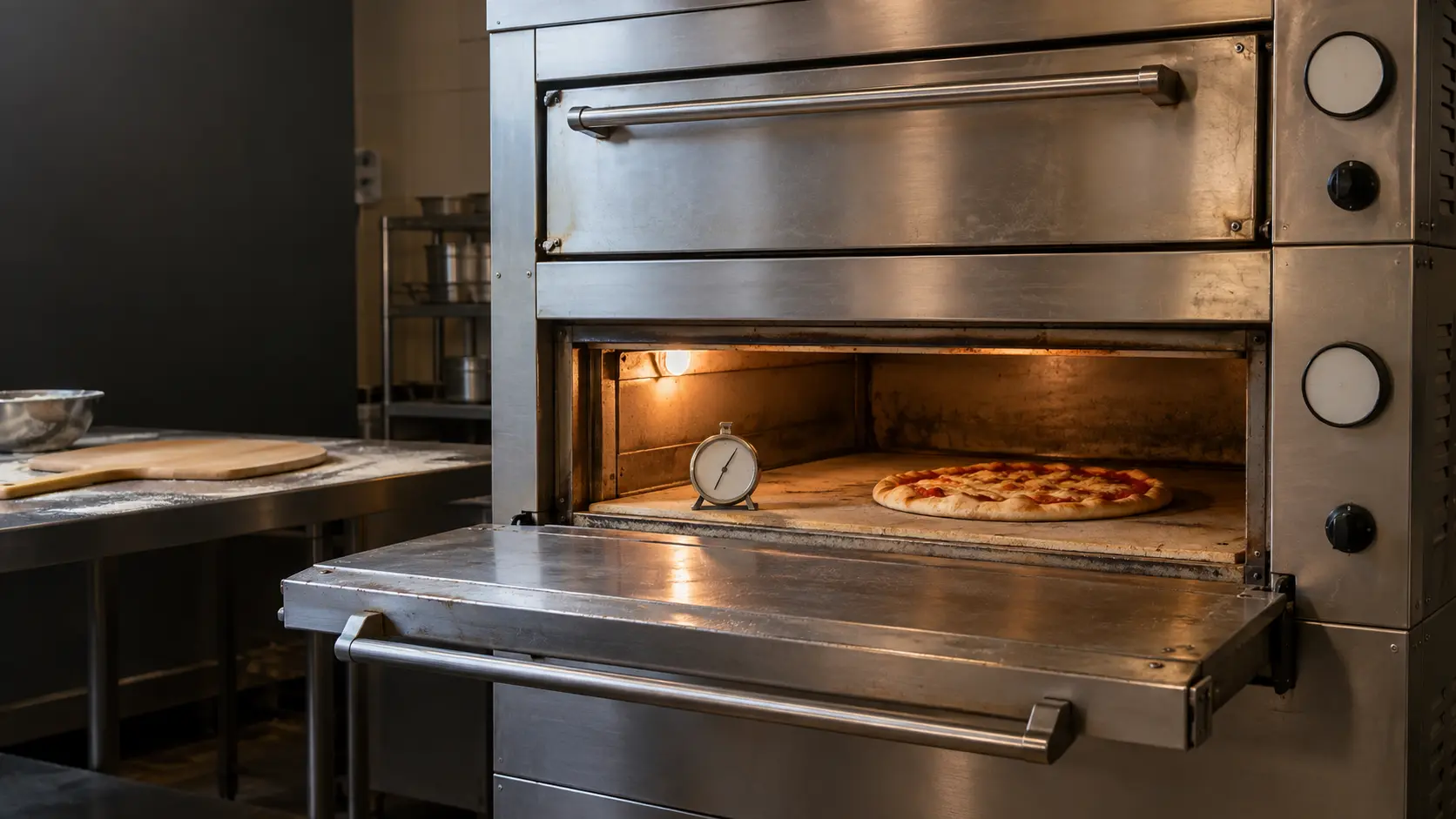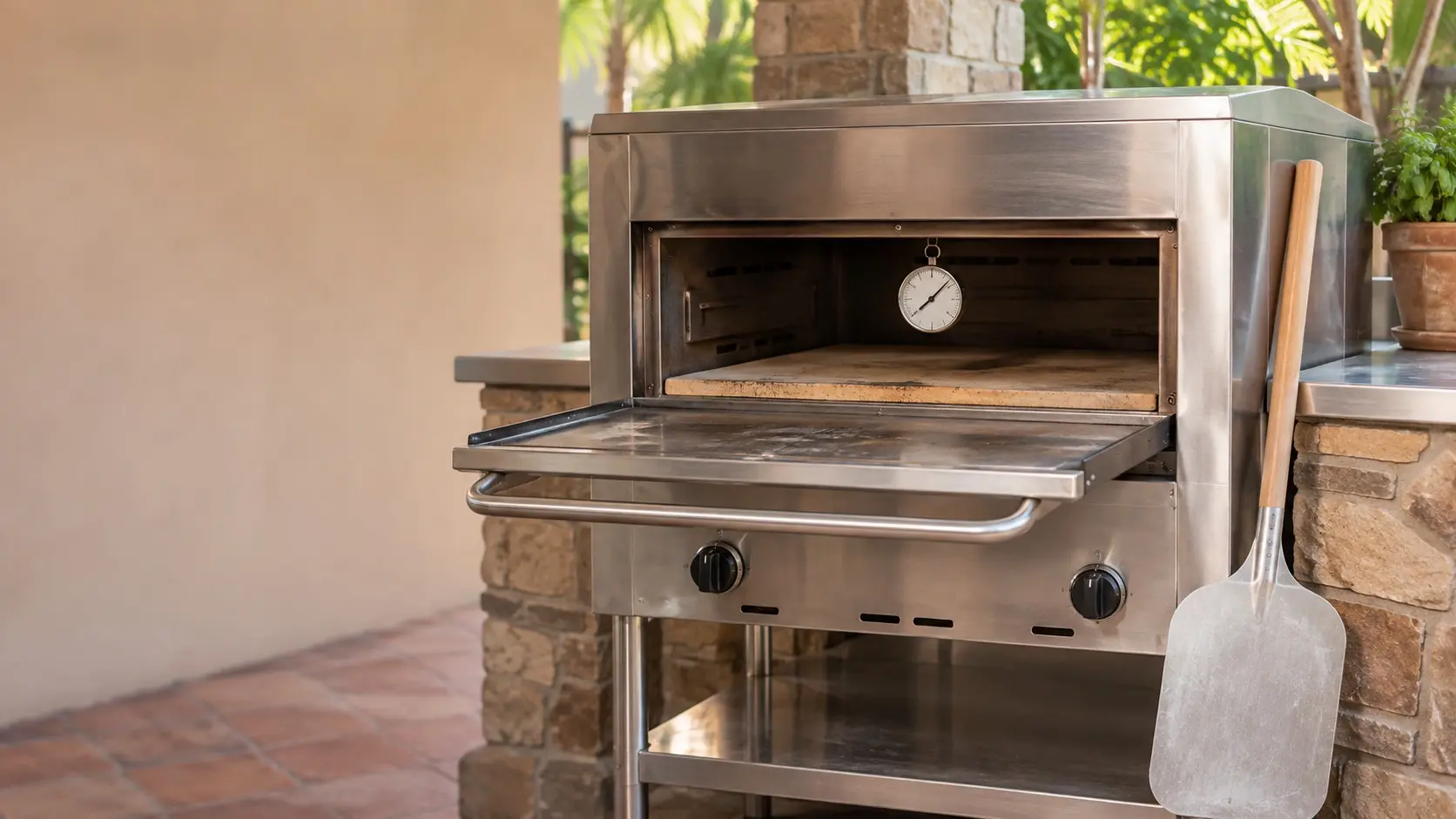

What does a pizza oven thermostat actually do?
It switches the heat on and off to hold the chamber near the number you set, and it does not tell you what the stone is doing. Two different temperatures matter in a pizza oven: the air in the chamber and the surface of the deck.
How it senses on each type of oven
- Gas deck ovens: a sealed bulb sits in the chamber and a thin tube, called a capillary, runs back to the gas control. As the bulb heats, the control throttles or closes the gas.
- Electric deck ovens: a thermostat or a control board reads a probe and switches the top and bottom elements, often with separate settings for each.
- Conveyor ovens: a probe feeds a controller with a display, and the controller holds the burners or elements by that reading.
- Wood-fired and many outdoor gas domes: there is no thermostat. You judge heat by a dial thermometer, an infrared reading and the fire itself.
Each of those has its own failure (a drifting deck oven is covered under deck oven temperature drifting), which is why a vague "the oven is off" does not help; it matters which kind you have, and the rating plate says.
How do I check whether the thermostat is accurate?
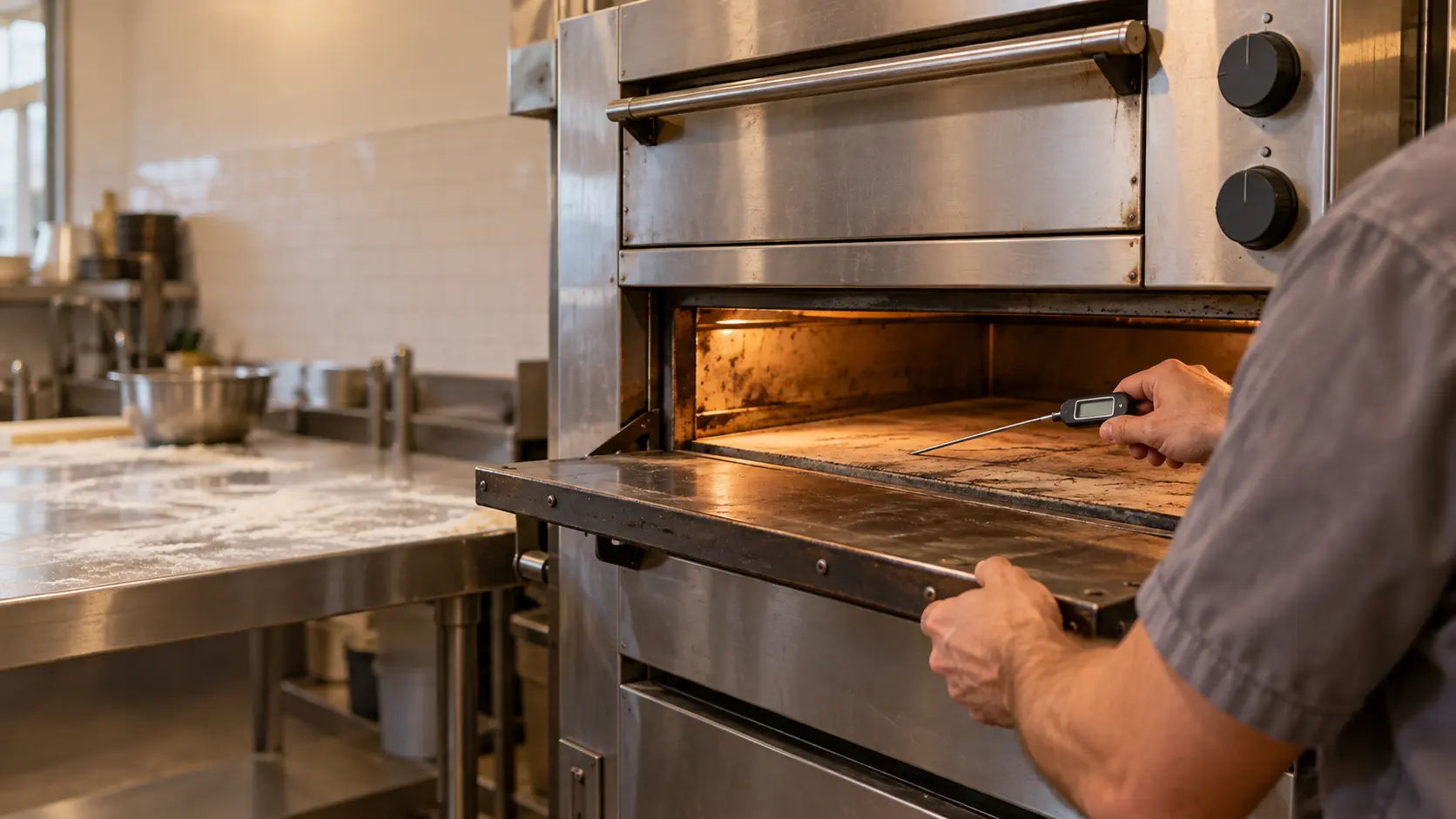
Compare the dial against two thermometers, after the oven has had time to settle. Taking one reading at one moment tells you very little.
- Place an oven-safe dial thermometer in the middle of the deck area, not against a wall, and a second one at the top of the chamber if you have one.
- Set the oven to a temperature you use, 500°F for example, and let it preheat fully with the door shut.
- Read the thermometer without opening the door for more than a second or two.
- Point an infrared thermometer at the center of the deck, and then at a spot near the wall.
- Write all the numbers down with the time, and repeat after 20 minutes.
What the readings tell you
| What you see | Likely meaning |
|---|---|
| Air reading near the dial, deck reading lower | Normal on a cold oven; deck stone needs longer to catch up |
| Air reading well off the dial and steady across repeats | Thermostat or probe out of calibration |
| Reading swings widely up and down | Control cycling poorly, or a bulb or probe in the wrong place |
| Hot spots near the wall, cooler center | Heat distribution and flame, not the thermostat |
| Never reaches the dial, burner always on | Low gas, a restricted burner, or a failed bulb |
A dial thermometer is usually good to within a small margin, and an infrared thermometer reads the surface it is aimed at, which on a bright stainless liner can be low. Use them to compare against each other, not as proof.

Why does a pizza oven overshoot or undershoot the dial?
The reasons depend on which way the error runs, and the cause is not always the thermostat.
Reading too low: the oven is hotter than the dial says
The bulb or probe may have shifted position, been coated in grease or scale, or drifted out of calibration. Pizzas burn on the bottom first, and the deck is hotter than the dial shows. A bulb that has been pushed against the chamber wall also reads wrong. Do not bend or move it to see what happens; the position is set at the factory.
Reading too high: the oven is cooler than the dial says
A control that cuts the gas too early, a failing bulb and a controller reading a worn probe all leave the oven below the setting. The usual suspects are the ones in why a pizza oven will not heat: a gas supply that cannot keep up, a clogged burner or an almost empty cylinder on a gas dome. If the oven never gets there at all, see a pizza oven not getting hot. Rule these out first, since they are far more common than a failed thermostat.
When the problem is the bake and not the number
If the temperature reads right but the pizza does not, look at the stone, the flame and the bake pattern before blaming the control. Keeping a deck oven baking even covers rotation, deck condition and the top-versus-bottom balance, and why the bottom burns and the top stays pale covers the most common bake complaint.
What can an owner check without opening anything?
Everything on this list stays on the outside of the oven, and none of it touches gas or wiring.
- The knob: make sure it is on the setting you think it is and that its pointer lines up with the markings.
- The door and gasket: a door that is not sealing lets heat out and makes the thermostat call for more.
- The deck: a cracked or filthy deck absorbs heat unevenly.
- The preheat: give a cold stone at least the time the maker allows, and judge heat after it.
- The power: on an electric or conveyor oven, check that the breaker and the switch are on.
- The display: write down any message exactly as it shows; the error codes page lists what the makers publish.
Do not change dial settings to compensate for a gap for more than a few tries. Setting the dial a certain number higher works for a while, but it hides a drift that will grow.
When does a thermostat or control need a technician?
When the readings show a steady error or erratic cycling, and the simple checks have not explained it. On a commercial deck oven, thermostat calibration, replacing a bulb and capillary, a probe or a control board, and testing a gas valve are bench-and-meter work and belong to a technician.
Give the technician what you wrote down: the model and serial from the plate, the dial setting, the air and deck readings with times, and the symptom. That shortens the visit and shows whether the part is the thermostat, the probe or something upstream. The page on thermostat and control repair describes what is checked on a visit.