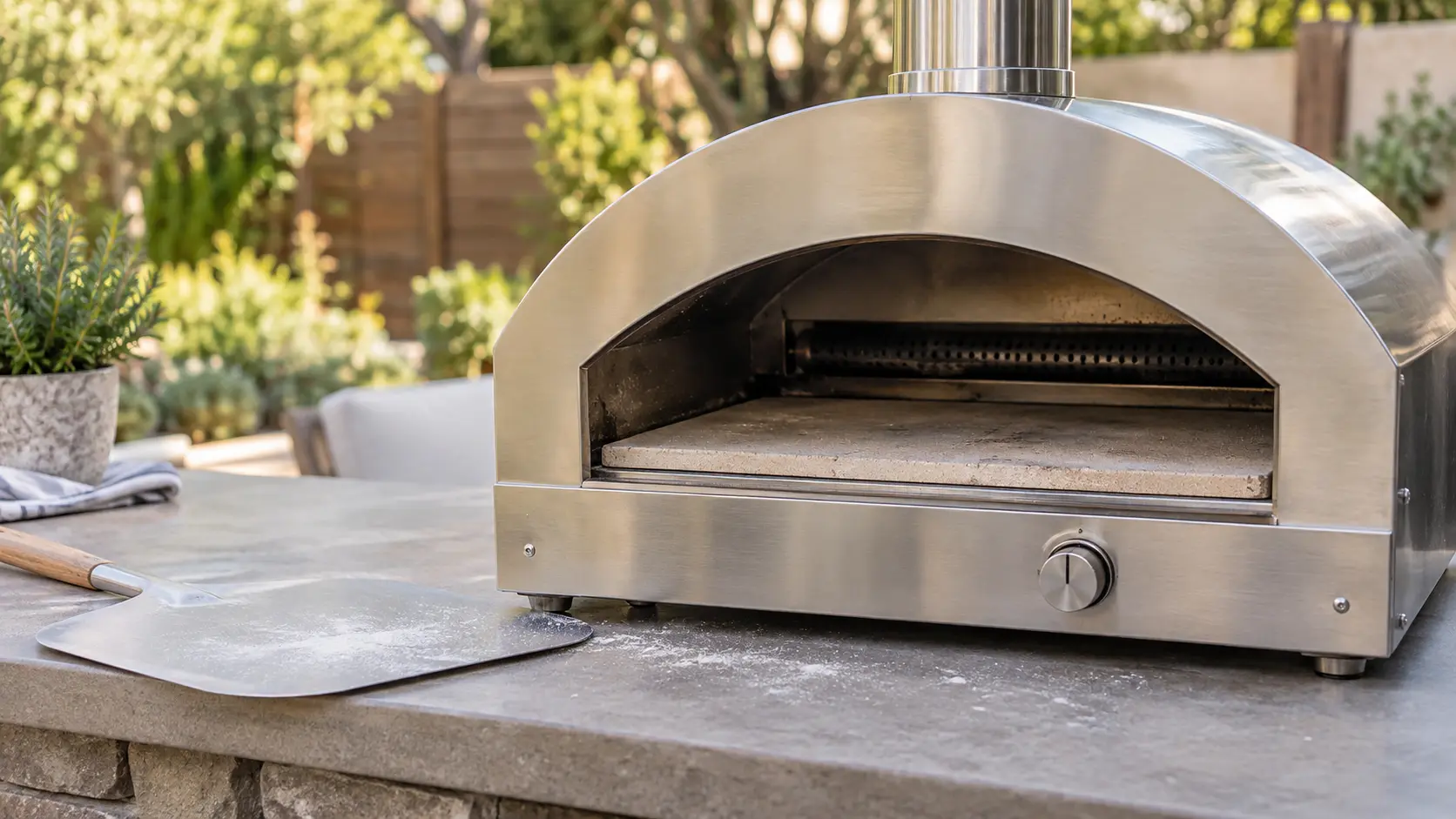

Name the oven and its fuel first
Begin with a clear photo of the rating plate, which carries the make, model, serial and the gas the burners were set up to burn; where to look for it on each kind of oven is in the rating plate guide in this section. Then write down which kind of oven it is, because the useful checks split four ways: an outdoor gas oven on a counter, cart or island; a wood-fired or hybrid dome; a gas or electric deck oven; or a conveyor or rapid-cook oven.
One sentence about the symptom and one about when it began are worth more than a long description. Trouble that shows up right after a cylinder change, a gas conversion, a storm, a deep clean or a move usually trace back to that event.
- Make, model and serial, copied off the plate.
- Gas type on the plate, and the gas the oven actually burns.
- What happens: will not light, will not hold a flame, slow to heat, uneven, a message on the screen.
- What changed just before: fuel, weather, cleaning, a move, a repair.
The gas supply, from the source to the knob
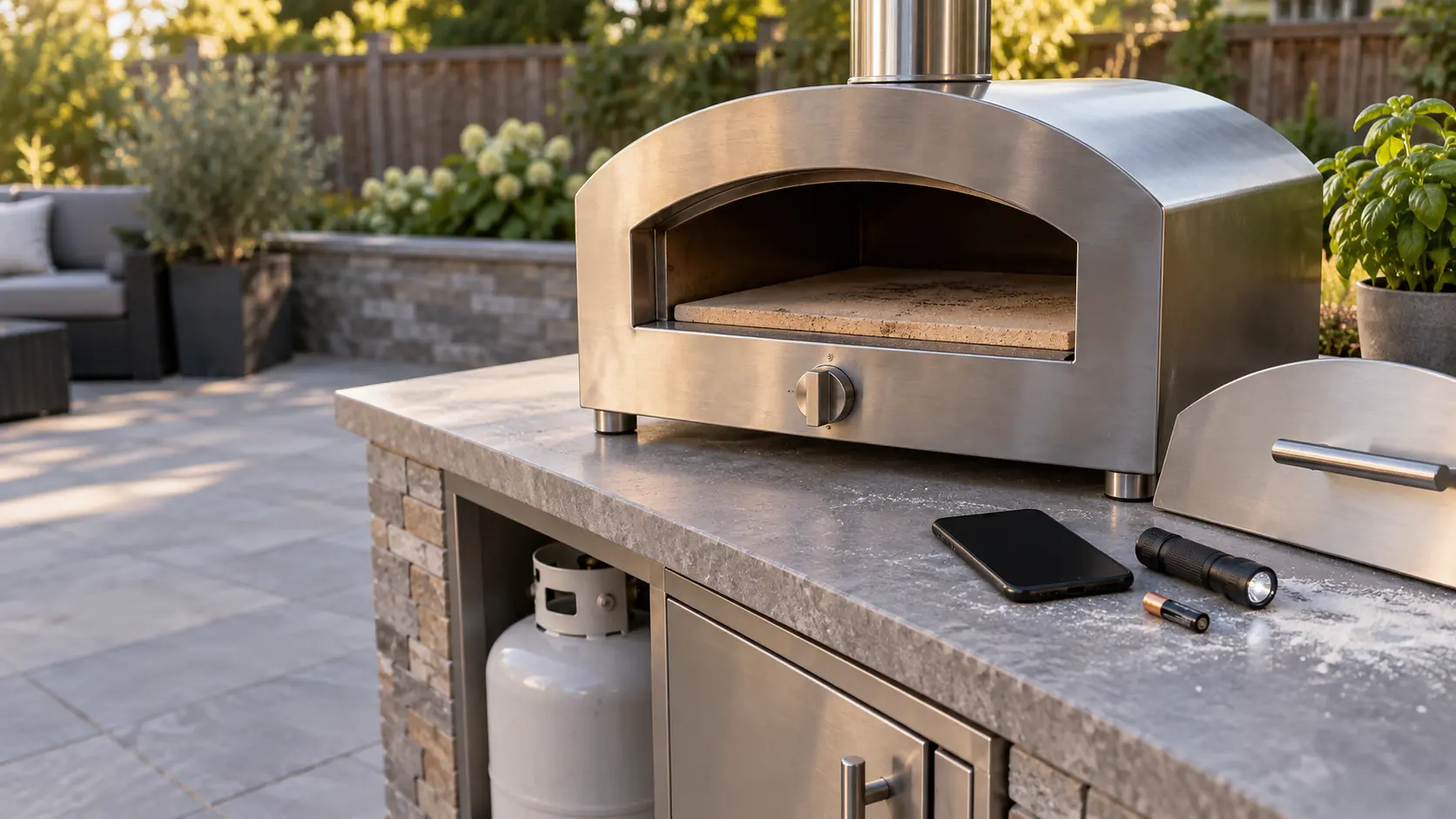
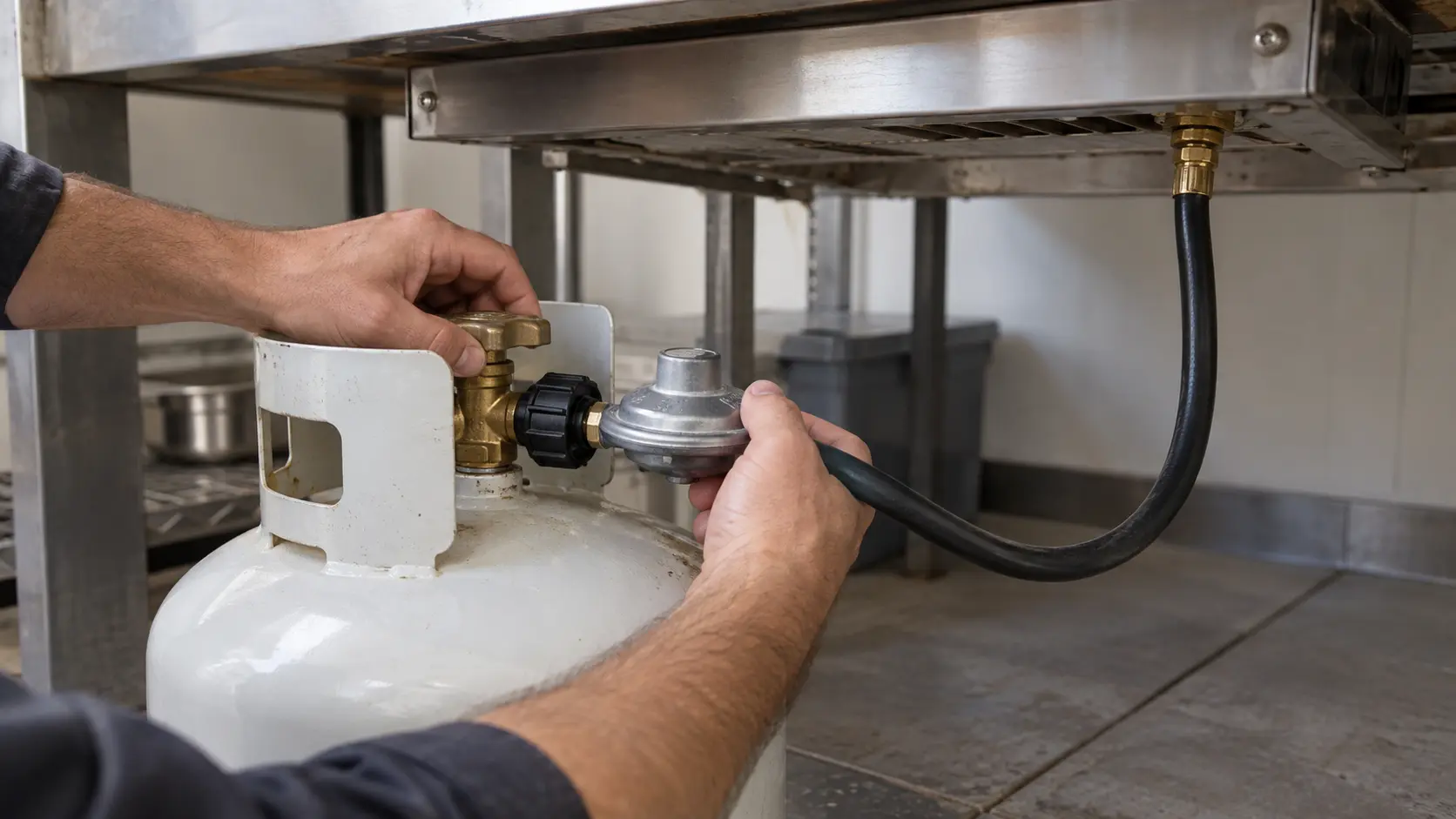
On a natural gas oven, locate the valve on the supply pipe beside the oven; its lever should point the same way the pipe runs. In a pizzeria, check the main gas valve as well; Middleby Marshall's first answer for a conveyor that will not heat is simply to make sure the main gas is on. On propane, lift or weigh the cylinder and check that its valve is open; Lynx notes that an almost empty cylinder may not have the pressure to run the burners at high heat.
Then follow the hose by eye. Look for kinks, cracking, a section resting against a hot surface, or a regulator pressed against the oven body, which Lynx asks owners to avoid because the regulator's diaphragm needs room to move. Should a burner knob have been on at the moment the cylinder was opened, clear the flow limiter as described in our guide on an oven that will not heat.
The five-minute wait between attempts
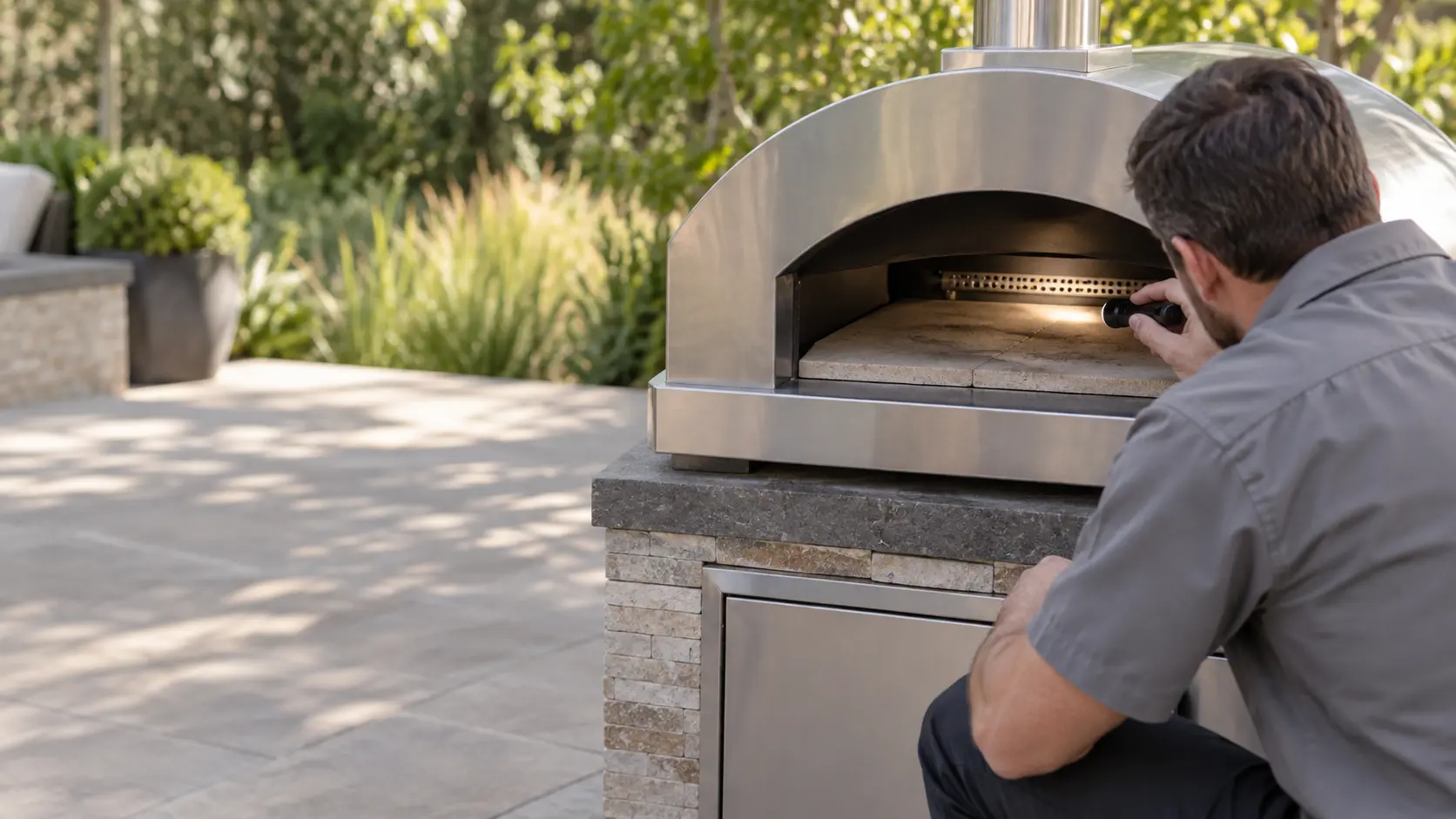
Lynx and Kalamazoo both say that when a burner does not light within about five seconds, the knob goes back to off and you wait five minutes for the gas to clear before trying again. Two careful attempts tell you as much as ten hurried ones, and they leave far less gas pooled in the chamber. Lynx also asks for the door off when lighting, so fuel does not collect in a closed oven.
Source: Lynx — Napoli outdoor oven use and install guide — Almost-empty cylinder lacks pressure; regulator must not touch the oven; no flame in 5 seconds: off and wait 5 minutes; door off when lighting; lights out: unplug 5 minutes for the transformer to reset; Middleby Marshall — PS640 gas conveyor oven owner's manual — Main gas on; breaker and emergency stop; belt off until temperature and energy-saving modes are normal; clogged front filters; jammed belt: clear when cool; blower and high temperature messages need service; blowers run until the oven drops below 200°F
Power, the breaker, the outlet and the spark
Outdoor ovens with lights, a rotisserie or hot-surface igniters need a live outlet, and many sit on a GFCI. Alfresco's first questions when its igniters do not glow are whether the cord is connected and whether the GFCI has tripped. Its spiral igniters should glow yellow-white within five to ten seconds of the knob reaching maximum, and it notes that if power drops while the oven runs, the safety gas valves close within ten to thirty seconds. For lights that stay dark, Lynx has owners unplug the oven and give its transformer five minutes to cool and reset before plugging back in.
In a pizzeria, start at the breaker or fused disconnect. Middleby Marshall's checklist for a conveyor oven that will not turn on also includes making sure the emergency stop button has not been pressed in.
Battery igniters on outdoor ovens
Many push-button igniters run on one cell. Kalamazoo uses a single AAA and says to replace it if the clicking is slow, faint or absent; Alfa's ignition button takes an AA, fitted with the oven off, and removed during long idle periods. A fresh cell costs almost nothing and ends a surprising share of no-light calls.
Source: Lynx — Napoli outdoor oven use and install guide — Almost-empty cylinder lacks pressure; regulator must not touch the oven; no flame in 5 seconds: off and wait 5 minutes; door off when lighting; lights out: unplug 5 minutes for the transformer to reset; Alfresco — AXE-PZA pizza oven care and use manual — Hot-surface igniters glow yellow-white within 5–10 seconds; check the cord and the GFCI; safety valves close within 10–30 seconds if power is lost; Middleby Marshall — PS640 gas conveyor oven owner's manual — Main gas on; breaker and emergency stop; belt off until temperature and energy-saving modes are normal; clogged front filters; jammed belt: clear when cool; blower and high temperature messages need service; blowers run until the oven drops below 200°F
Wood-fired and hybrid domes: ash, wood, door and feet
With the oven stone cold, look at the floor. A thick bed of old ash starves a new fire of air and insulates the stone from it. Check the wood next: split hardwood that is dry, light for its size and cracked at the ends, not softwood or anything painted, stained or engineered, which Coyote rules out because it coats the oven and flue with soot and creosote.
Then look at the door and the base. A warped door that leaves a wide gap sheds heat. Alfa's countertop ovens have to stand on their supplied feet so air can flow under the floor; an oven set flat on the counter heats and behaves differently. Look at the chimney only from the ground: a cap bent over or a nest visible at the top is a note for the booking.
Source: Alfa Forni — User manual, domestic ovens (North America) — Ignition button uses an AA battery, fitted with the oven off, removed during long idle periods; ovens must stand on their feet for airflow under the floor; Coyote — Wood-fired pizza oven owner's manual — No softwood, painted, stained, plywood or engineered wood: excess soot and creosote in the oven and flue
Deck and conveyor controls: read the message
Digital controls usually say what they are unhappy about. Write the message down exactly, with any letters and numbers, and photograph the screen. Several messages on a Middleby Marshall PS640 describe normal operation: the belt stays off until the oven reaches temperature, and two energy-saving modes are listed as normal. Others have an owner-level answer; clogged front filters raise the control compartment temperature, and cleaning or replacing them clears it.
A jammed belt message calls for the oven off and cool, then a look for whatever has blocked the belt. A message naming the blowers or a high temperature error is for a technician, as the same manual says.
Messages that are not a failure
- Belt waiting for temperature during warm-up.
- An energy-saving mode after a quiet stretch.
- Cool-down with the blowers still running after the oven is switched off hot.
- A lock or menu message after someone pressed the wrong key.
Source: Middleby Marshall — PS640 gas conveyor oven owner's manual — Main gas on; breaker and emergency stop; belt off until temperature and energy-saving modes are normal; clogged front filters; jammed belt: clear when cool; blower and high temperature messages need service; blowers run until the oven drops below 200°F