Why a deck oven bakes unevenly
A deck bakes along two paths at once: heat conducted from the stone into the crust, and hot air and radiant heat falling on the top. Anything that shifts the balance between them shows up as pale tops over burnt bottoms, or the reverse, and anything that heats one patch of stone more than another shows up as a pie finished on one side only. Keeping a deck oven baking evenly starts with finding which of these is at work.
- Doors opened often or left open, which Blodgett lists among the causes of uneven bakes.
- Dough scaled inconsistently, or pans that have warped.
- Poor ventilation, or an exhaust fan pulling too hard, which Bakers Pride links to burnt bottoms.
- Gas pressure that swings as other equipment on the line cycles on and off.
- Flame diverters under the deck that are damaged or pushed out of place.
- Stones caked with burnt residue or sitting out of level.
Hot edges and a tired center
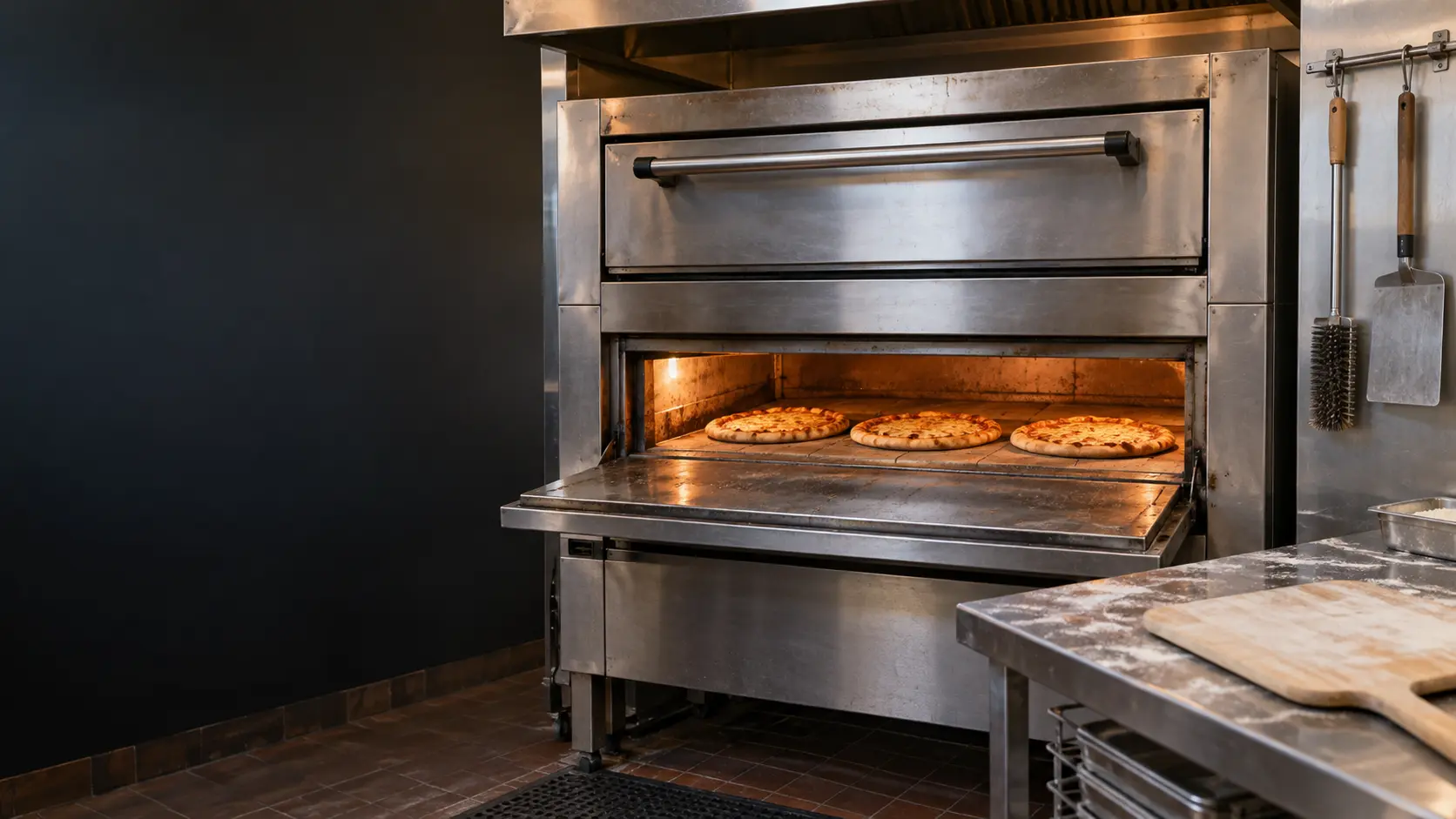
The stone beside the walls runs hotter than the middle, and the spot where every pie lands cools a little with each bake. Bakers Pride's answer is a half turn once during each bake, or pies kept to the center, and moving pies onto unused stone when their bottoms start coming out underdone.
Source: Bakers Pride — floor model gas deck oven operation manual (U4114A) — Areas next to the walls are hotter; rotate pies 180° once per bake or keep to the center; a repeatedly used area cools; exhaust fan too powerful burns bottoms; flame diverters distribute heat and must be in place; damper plate and micro slides for top and bottom heat; reduce thermostat 50–75°F in slow periods; turn it up for a single pie in an idle oven; preheat 1 to 1-1/2 hours 50°F below baking temperature; close slides halfway after the 4th or 5th bake; pilot position overnight; scrape and wire-brush decks, burn off at maximum for at least 1/2 hour, never water, turn soiled decks over; decks leveled with metal shims; only pizza and bread on ceramic decks; door parts inspected every six months and not greased.; Blodgett — 1048 gas deck oven installation, operation and maintenance manual — Uneven bakes from poor ventilation, doors left open, improper dough scaling, fluctuating gas pressure and warped pans; clean Ultra Rokite decks with a triangular scraper and no water or liquids; rotate product placement and alternate upper and lower sections; weekly brushing of the combustion compartment and air intakes; six-month cleaning of secondary air ducts.
Balancing top heat against bottom heat
Bakers Pride gas decks carry an instruction plate behind the damper knobs. Opening the dampers lets more heat from the burner compartment into the baking chamber for top color; closing them keeps the heat below to hold the deck hotter. The micro slides make the same trade in finer steps, pulled closed to cut top heat and pushed open when tops lag behind the bottoms.
Electric decks do it with numbers instead. Marra Forni's stackable electric decks set upper and lower heat separately, and each deck has a manual damper vent to let moisture out when a product wants a drier bake.
Slow hours and the first pie after
An idle deck keeps soaking up heat and runs hotter than its setting suggests. For bottoms that burn in quiet hours, Bakers Pride suggests setting the thermostat 50 to 75°F below normal and raising it again as soon as baking resumes. With a single pie going into a hot, idle oven it suggests the opposite trick: turn the thermostat up so the burner runs full and the top keeps pace, then set it back once that pie is out.
Source: Bakers Pride — floor model gas deck oven operation manual (U4114A) — Areas next to the walls are hotter; rotate pies 180° once per bake or keep to the center; a repeatedly used area cools; exhaust fan too powerful burns bottoms; flame diverters distribute heat and must be in place; damper plate and micro slides for top and bottom heat; reduce thermostat 50–75°F in slow periods; turn it up for a single pie in an idle oven; preheat 1 to 1-1/2 hours 50°F below baking temperature; close slides halfway after the 4th or 5th bake; pilot position overnight; scrape and wire-brush decks, burn off at maximum for at least 1/2 hour, never water, turn soiled decks over; decks leveled with metal shims; only pizza and bread on ceramic decks; door parts inspected every six months and not greased.; Marra Forni — ELST37-32/1 stackable electric oven specification sheet — Individually adjustable upper and lower temperatures; a manually controlled damper vent on each deck for humidity evacuation.

Keeping the deck stones clean and level
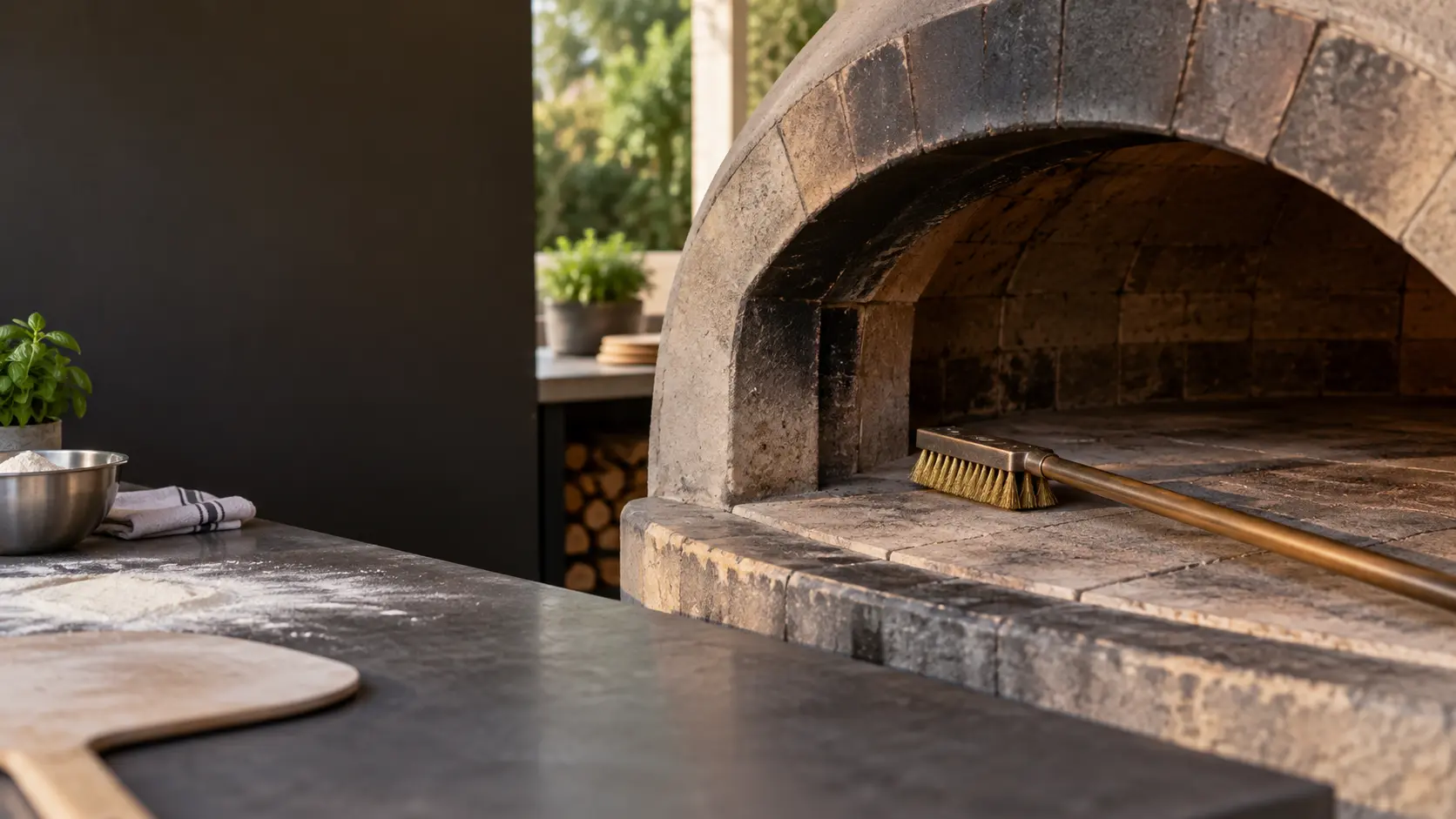
Burnt flour and cheese left on the stone insulate it, slow the bake and add an off flavor. Bakers Pride scrapes and brushes its decks through the day with a long-handled scraper and a stiff wire brush, runs the oven at its highest setting for at least half an hour at closing to reduce spills to ash, and brushes the ash off the next morning before lighting. Blodgett cleans its Ultra Rokite decks with a triangular scraper.
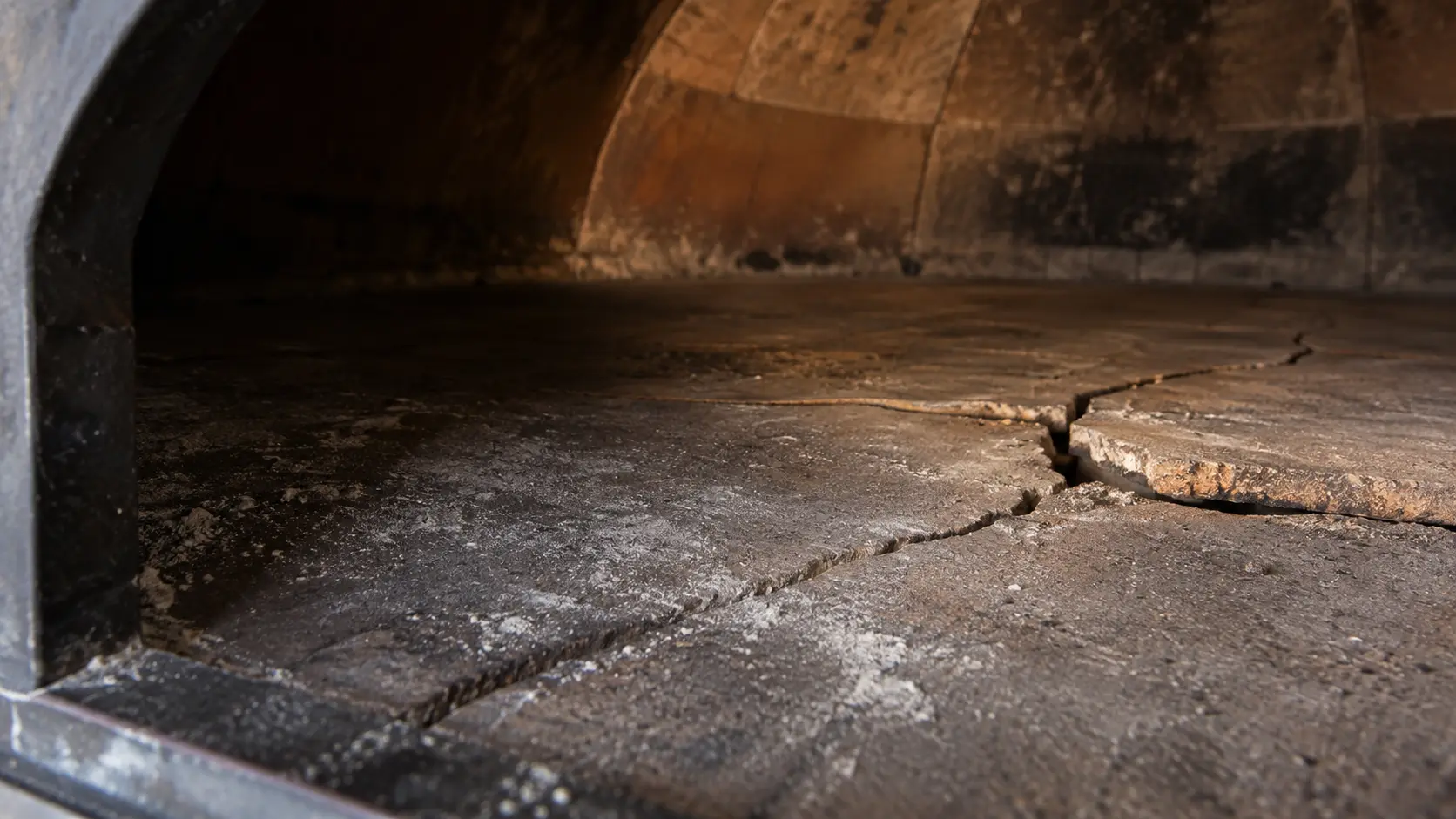
- No water or other liquid on the decks at any time; both makers warn it can crack them.
- Vacuum heavy crumbs and carbon only when the oven is cold.
- Heavily soiled decks can be scraped and turned over, so the next firing burns off the dirty side, per Bakers Pride.
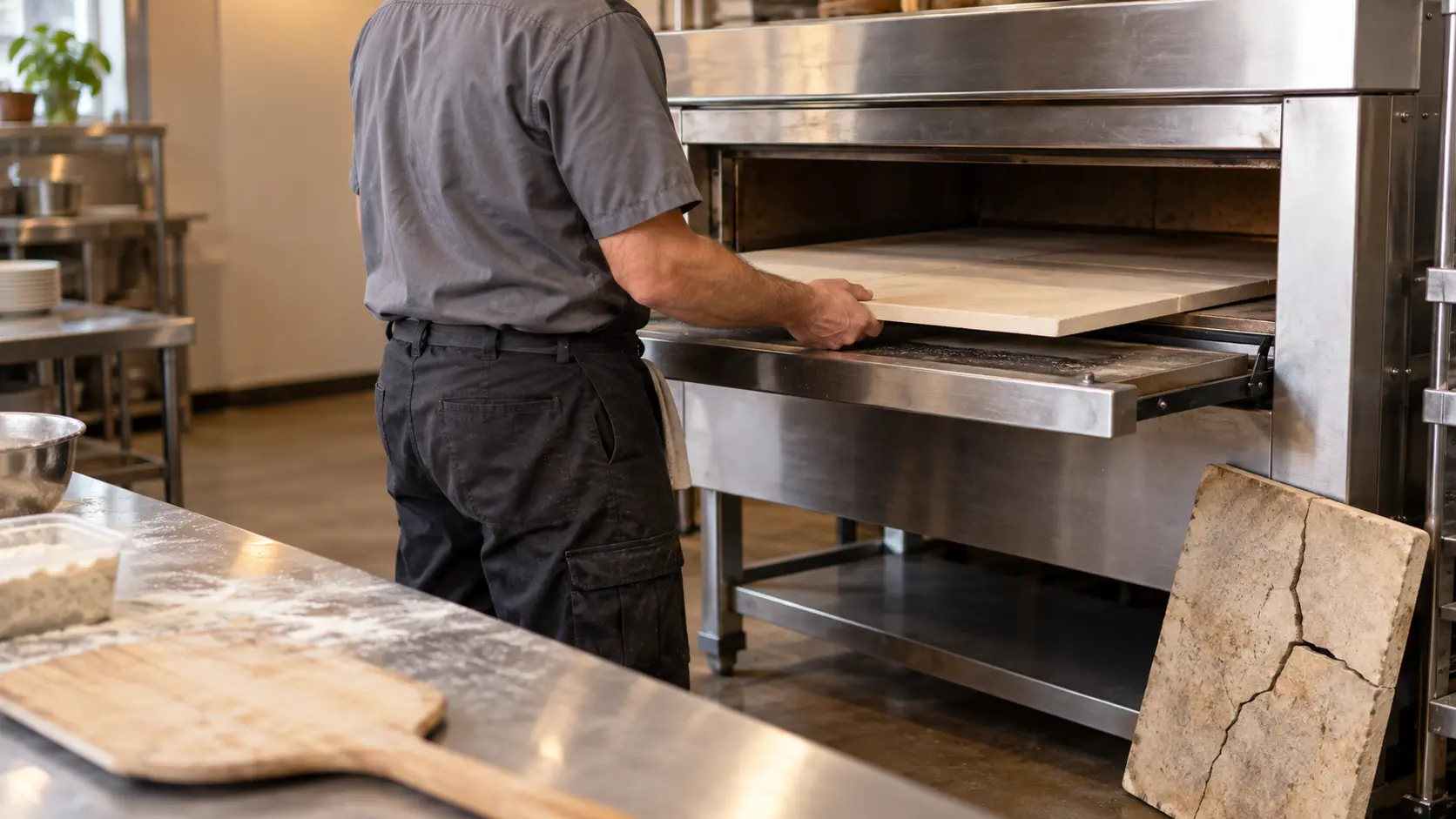
- Decks are leveled on metal shims at installation; one that rocks or shows a raised edge needs releveling by whoever services the oven.
Only pizza and bread on the stone
Bakers Pride allows only pizza and bread products to touch its ceramic decks; everything else goes in a pan or container. Fat from a tray of wings or a roast has nowhere to go but into the stone, where it smokes and darkens the pies baked over it afterward.
Source: Bakers Pride — floor model gas deck oven operation manual (U4114A) — Areas next to the walls are hotter; rotate pies 180° once per bake or keep to the center; a repeatedly used area cools; exhaust fan too powerful burns bottoms; flame diverters distribute heat and must be in place; damper plate and micro slides for top and bottom heat; reduce thermostat 50–75°F in slow periods; turn it up for a single pie in an idle oven; preheat 1 to 1-1/2 hours 50°F below baking temperature; close slides halfway after the 4th or 5th bake; pilot position overnight; scrape and wire-brush decks, burn off at maximum for at least 1/2 hour, never water, turn soiled decks over; decks leveled with metal shims; only pizza and bread on ceramic decks; door parts inspected every six months and not greased.; Blodgett — 1048 gas deck oven installation, operation and maintenance manual — Uneven bakes from poor ventilation, doors left open, improper dough scaling, fluctuating gas pressure and warped pans; clean Ultra Rokite decks with a triangular scraper and no water or liquids; rotate product placement and alternate upper and lower sections; weekly brushing of the combustion compartment and air intakes; six-month cleaning of secondary air ducts.
A daily routine that keeps bakes even
Consistency starts before the first order. These habits come straight from the two makers' manuals and cost nothing but attention.
- Preheat 1 to 1-1/2 hours at 50°F below the baking temperature, then raise it, as Bakers Pride instructs.
- After the fourth or fifth bake, close the slides about halfway if the bottoms need help holding their color.
- Load across the whole deck in rotation rather than on one favorite spot, and alternate the upper and lower sections of a double oven, as Blodgett advises.
- Open the doors only to load, turn and pull.
- At closing, turn a gas deck to its pilot position for the night instead of leaving it on a high setting.
Weekly and six-month checks
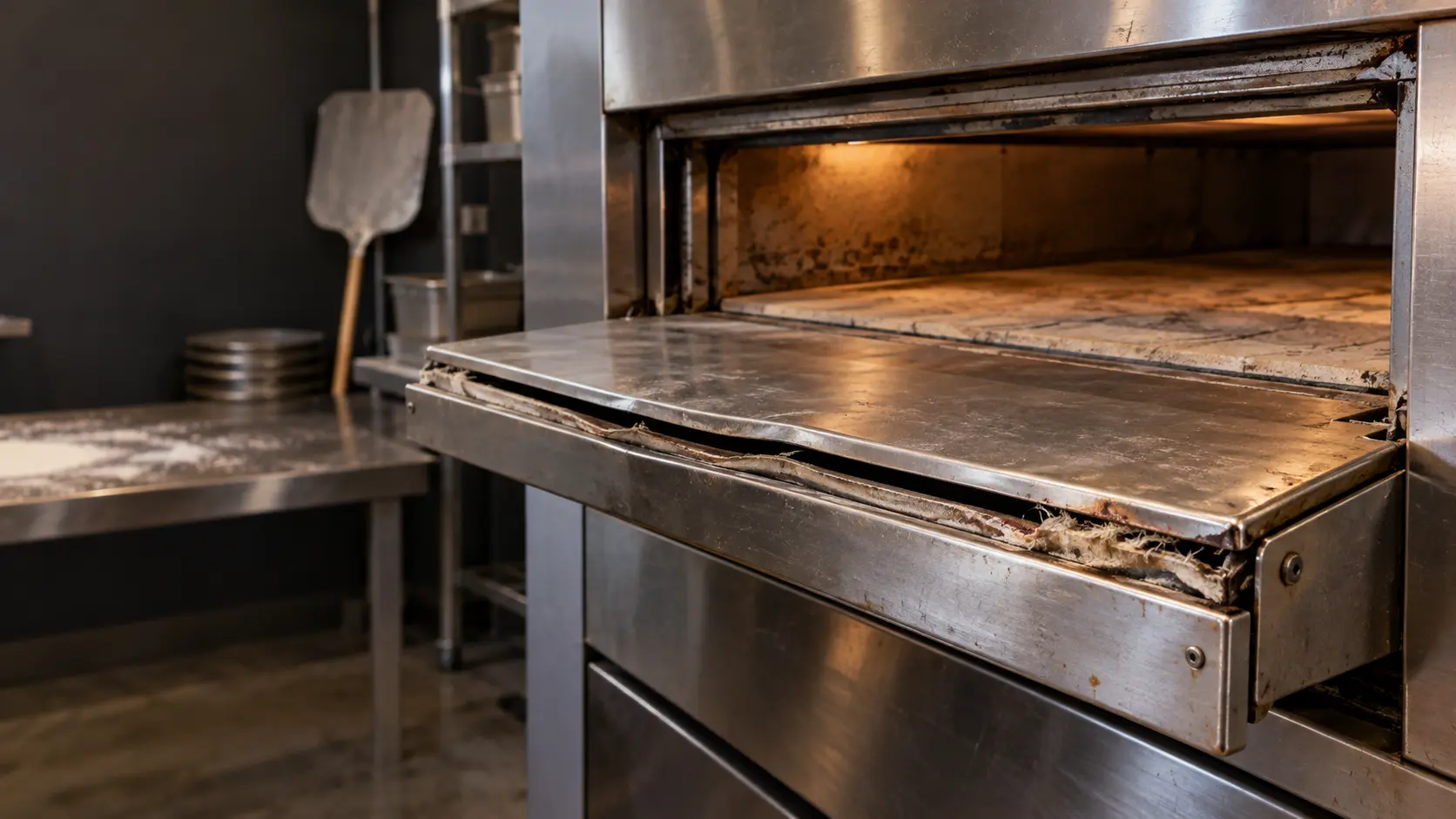
Blodgett has staff brush out the combustion compartment and control area and clear the air intakes each week, since those intakes cool the parts inside, and clean the secondary air ducts every six months. Bakers Pride puts its door springs and moving parts on a six-month inspection too, and warns against greasing the door rod and pins, whose self-lubricating inserts are damaged by it.
Source: Bakers Pride — floor model gas deck oven operation manual (U4114A) — Areas next to the walls are hotter; rotate pies 180° once per bake or keep to the center; a repeatedly used area cools; exhaust fan too powerful burns bottoms; flame diverters distribute heat and must be in place; damper plate and micro slides for top and bottom heat; reduce thermostat 50–75°F in slow periods; turn it up for a single pie in an idle oven; preheat 1 to 1-1/2 hours 50°F below baking temperature; close slides halfway after the 4th or 5th bake; pilot position overnight; scrape and wire-brush decks, burn off at maximum for at least 1/2 hour, never water, turn soiled decks over; decks leveled with metal shims; only pizza and bread on ceramic decks; door parts inspected every six months and not greased.; Blodgett — 1048 gas deck oven installation, operation and maintenance manual — Uneven bakes from poor ventilation, doors left open, improper dough scaling, fluctuating gas pressure and warped pans; clean Ultra Rokite decks with a triangular scraper and no water or liquids; rotate product placement and alternate upper and lower sections; weekly brushing of the combustion compartment and air intakes; six-month cleaning of secondary air ducts.