
What keeps a flame lit once you let go
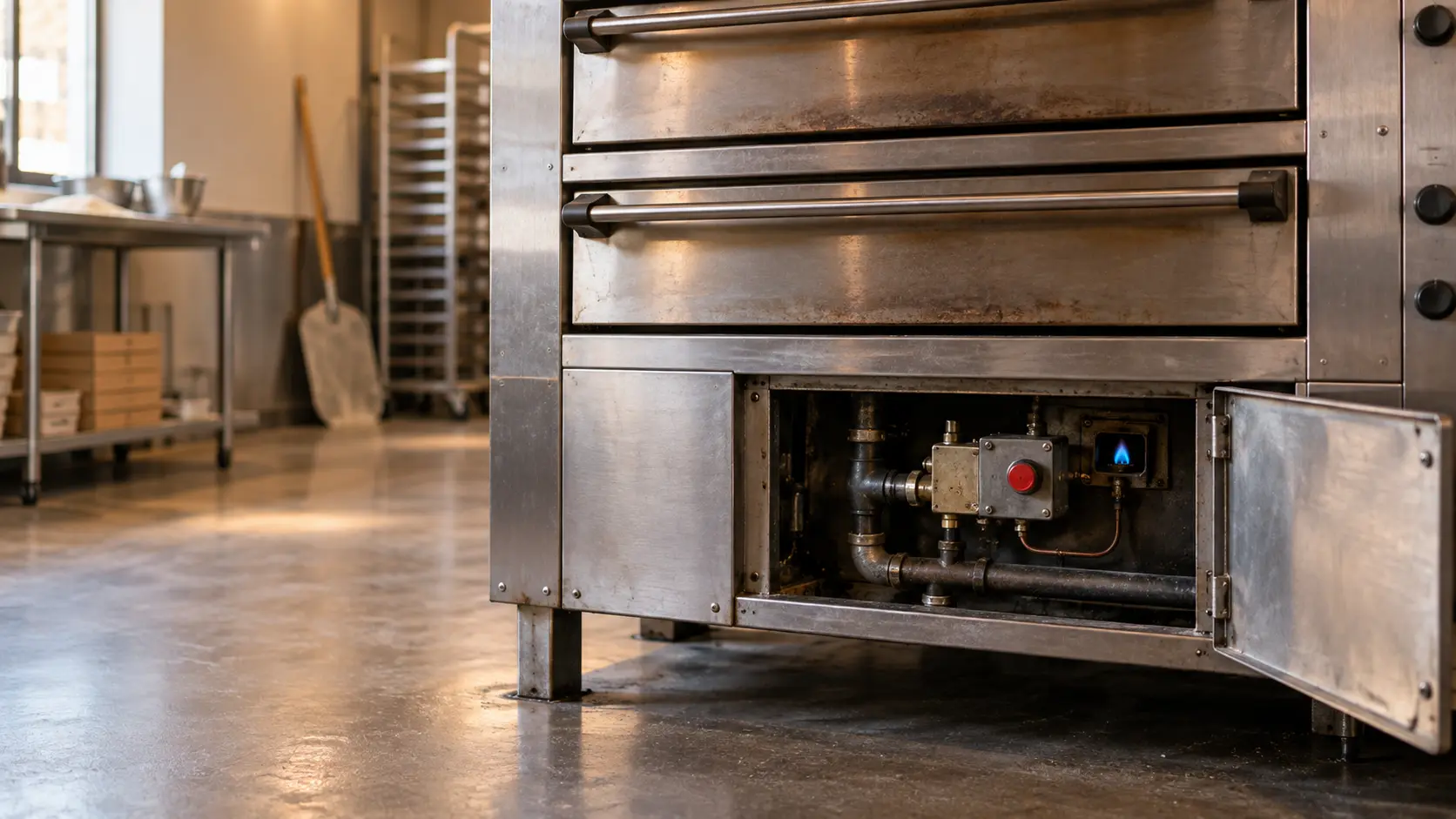
Standing pilots and many outdoor burners use a thermocouple, or on some deck ovens a thermopile: a metal tip that sits in the flame and makes a tiny current when hot. That current holds a small magnet in the gas valve open. Until the tip is hot, the valve is held open only by your thumb on the knob or button, and the instant you release it early, the gas stops.
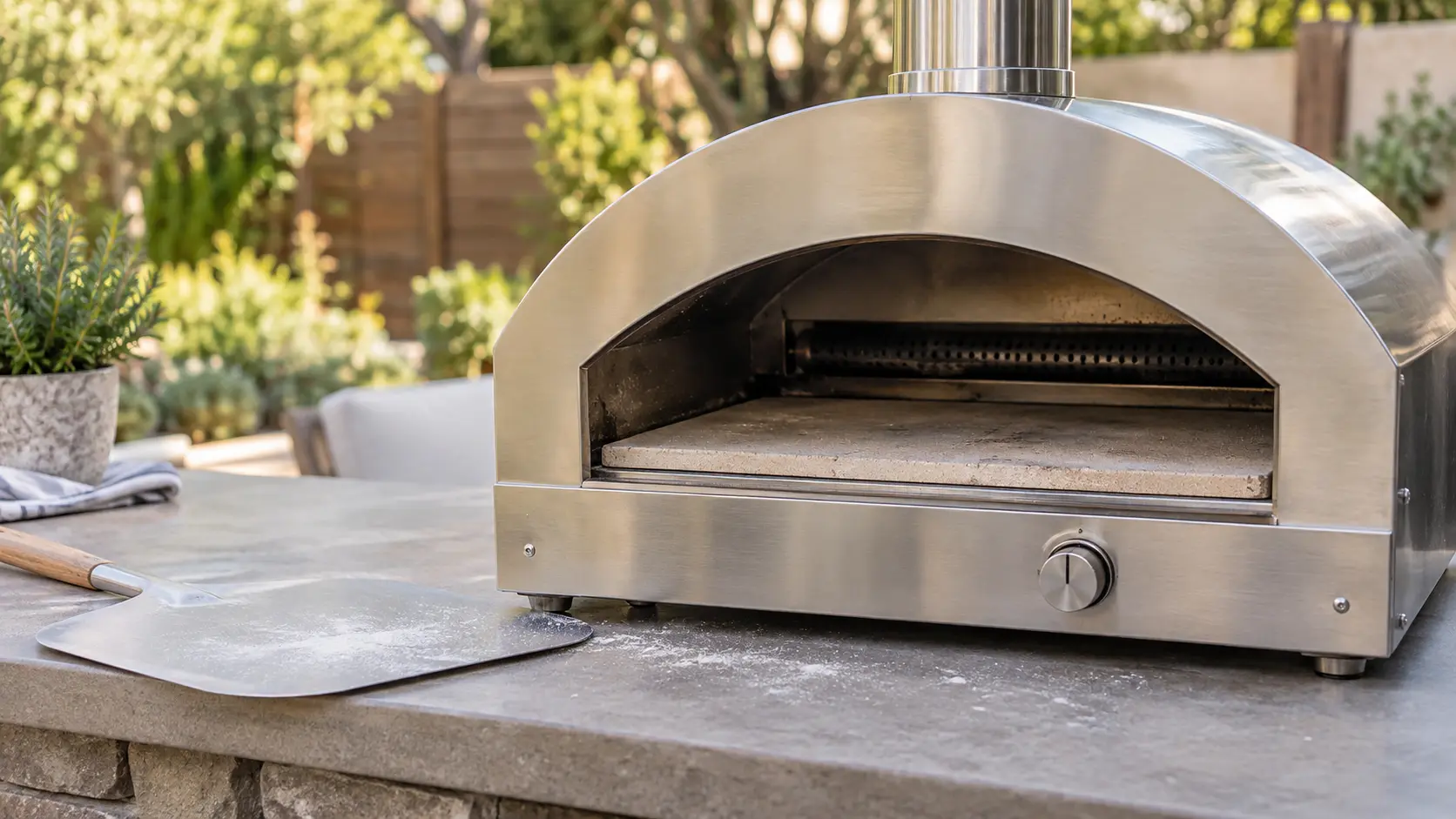
So the first suspect is simply time. Lynx asks owners of its Napoli oven to keep the knob pressed for ten to twenty seconds after ignition; Kalamazoo says at least ten, and explains that its lower and upper burners each have their own thermocouple. On deck ovens the wait is longer: Blodgett's 1060 has the red pilot button held for about thirty seconds after the pilot lights, and Bakers Pride gives the same half minute for its floor models.
Hold times from the makers' manuals
- Lynx Napoli: knob held in 10 to 20 seconds after the burner lights.
- Kalamazoo Artisan Fire: at least 10 seconds for each burner.
- Blodgett 1060 deck: red pilot button held about 30 seconds.
- Bakers Pride floor deck: red button about 30 seconds; the main valve opens fully one to two minutes later.
Source: Lynx — Napoli outdoor oven use and install guide — Keep the knob in 10 to 20 seconds after ignition while the thermocouple heats; releasing early shuts the gas; no flame in 5 seconds: off and wait 5 minutes; Kalamazoo — Artisan Fire pizza oven use and care guide — Hold at least 10 seconds; each burner has its own thermocouple; wait 5 minutes after a failed attempt; do not place the oven where the door opening faces strong wind; Blodgett — 1060 gas deck oven installation, operation, maintenance — After the pilot lights, keep the red button depressed about 30 seconds
Relighting by the plate, with a wait between tries
Deck ovens carry lighting instructions on or near the valve, and they are worth following word for word. Bakers Pride's sequence starts with the red handle on the gas shutoff turned off and a five-minute wait so any gas in the burner compartment can escape, then the red button is pressed and the pilot lit and held. If the pilot fails to light or will not stay lit, the manual says to repeat those same steps from the beginning, wait included.
Outdoor ovens follow the same logic. Lynx and Kalamazoo both say that when the flame does not appear within about five seconds the knob goes to off for five minutes. Keep your face away from the mouth while lighting, and stop after two or three careful tries; a pilot that will not hold after that is telling you something a fourth attempt will not change.
A knob that goes in too far
Alfa lists one mechanical cause worth checking on its gas ovens: if the knob is pushed in so far that it hits, the pilot may not get the gas it needs to light. A knob that has slipped on its shaft, or a bezel that has shifted after cleaning, can cause the same thing. Look at whether the knob sits square and at the same depth as its neighbor; do not pull the valve or panel apart to find out.
Source: Lynx — Napoli outdoor oven use and install guide — Keep the knob in 10 to 20 seconds after ignition while the thermocouple heats; releasing early shuts the gas; no flame in 5 seconds: off and wait 5 minutes; Kalamazoo — Artisan Fire pizza oven use and care guide — Hold at least 10 seconds; each burner has its own thermocouple; wait 5 minutes after a failed attempt; do not place the oven where the door opening faces strong wind; Bakers Pride — Y600/Y800 series deck ovens operation manual — Shutoff off and wait five minutes, then hold the red button about 30 seconds; valve opens fully after 1–2 minutes; pilot normally stays lit day and night; correct pilot flame size; thermopile out of the flame or defective; pilot position overnight

Wind, draft and slamming doors
A pilot flame is small, and air moving past it can bend it away from the sensor tip or blow it out. Outdoors, Kalamazoo tells owners not to place its pizza oven where the door opening is likely to face strong wind. An oven that lights every calm evening and loses its flame on breezy ones is usually telling you about its placement, not about a part; a screen or a new spot out of the prevailing wind often ends it.
Indoors the air moves too. A deck oven under a powerful hood, near a back door that swings open all evening or beside a fan can lose its pilot in a draft that nobody notices. Note whether it goes out at particular times: at opening, at the rush, when the delivery door is propped open.
Habits that help an outdoor oven hold its flame
- Light with the door off, as most manuals ask, then fit it once the burner is steady.
- Stand upwind of the mouth, and move anything that funnels a breeze into it, such as a propped-up cover or an open gate.
- Give a windy evening a longer hold on the knob before letting go.
- Keep the burner area free of leaves and grit that disturb the flame.
Source: Kalamazoo — Artisan Fire pizza oven use and care guide — Hold at least 10 seconds; each burner has its own thermocouple; wait 5 minutes after a failed attempt; do not place the oven where the door opening faces strong wind
A weak pilot flame or a tired sensor
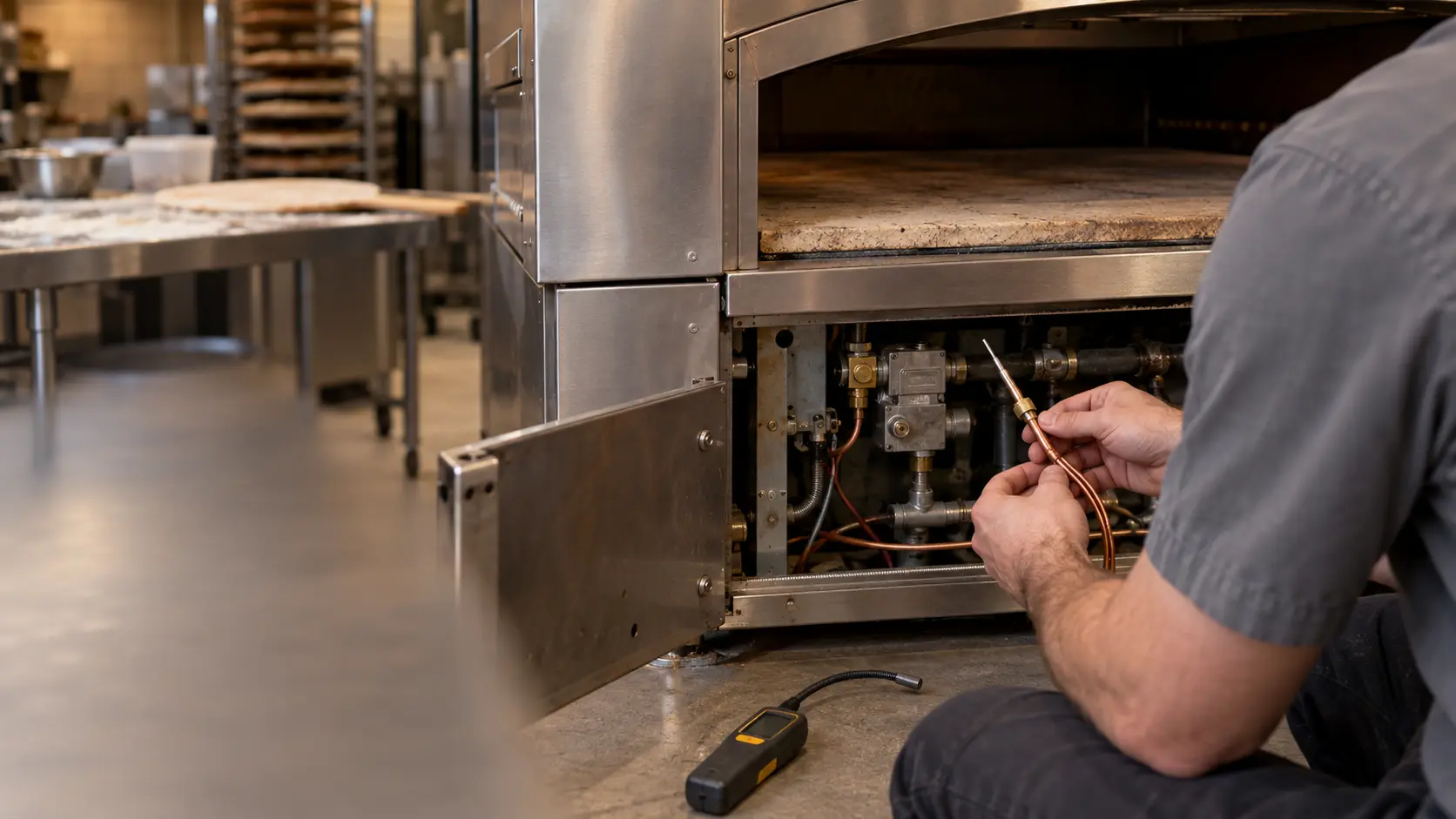
The flame has to wrap the sensor tip. Bakers Pride stresses that the pilot flame must be the correct size and lists a thermopile sitting outside the pilot flame, or a thermopile that has failed, among the reasons the main burners will not light. On a busy deck, flour dust and grease settle in the tiny pilot orifice over the months and shrink the flame until it no longer reaches the tip.
Sensors wear too. Every heat cycle ages a thermocouple, and its connection at the valve can loosen. Both are simple parts for a technician and not ones to bend, sand or tighten from the front of a live oven. Nothing should ever be used to hold the safety valve open: a jammed button or a weighted knob removes the one thing that stops raw gas when the flame goes out.
Notes that speed up the visit
How long you held the knob or button, whether the pilot flame looked small, yellow or lifting, whether it goes out at once or after minutes or hours, and whether wind, the hood or a door seems to be involved. On outdoor ovens with a flame sensor on the main burner, note whether the burner dies on release or after running for a while.
Source: Bakers Pride — Y600/Y800 series deck ovens operation manual — Shutoff off and wait five minutes, then hold the red button about 30 seconds; valve opens fully after 1–2 minutes; pilot normally stays lit day and night; correct pilot flame size; thermopile out of the flame or defective; pilot position overnight
Pizza ovens with no standing pilot
Many newer ovens light the burner directly with a spark or a hot-surface igniter and prove the flame electronically. When those lose their flame the symptom is a burner that lights and then shuts down, often with a message. Alfresco notes that if the power drops while its pizza oven is running, the safety gas valves close within ten to thirty seconds and the oven resumes once power returns, so a flicker on the circuit can look like a flame problem. Middleby Marshall's advice for a conveyor burner that does not light is to switch the oven off, restart it once and call for service if it still fails.
Source: Alfresco — AXE-PZA pizza oven care and use manual — If power is interrupted, the safety gas valves close within 10 to 30 seconds and the unit resumes when power returns; Middleby Marshall — PS640 gas conveyor oven owner's manual — Burner did not light: turn the oven off and restart; if it still does not light, call for service