Hairline crazing is part of how refractory behaves
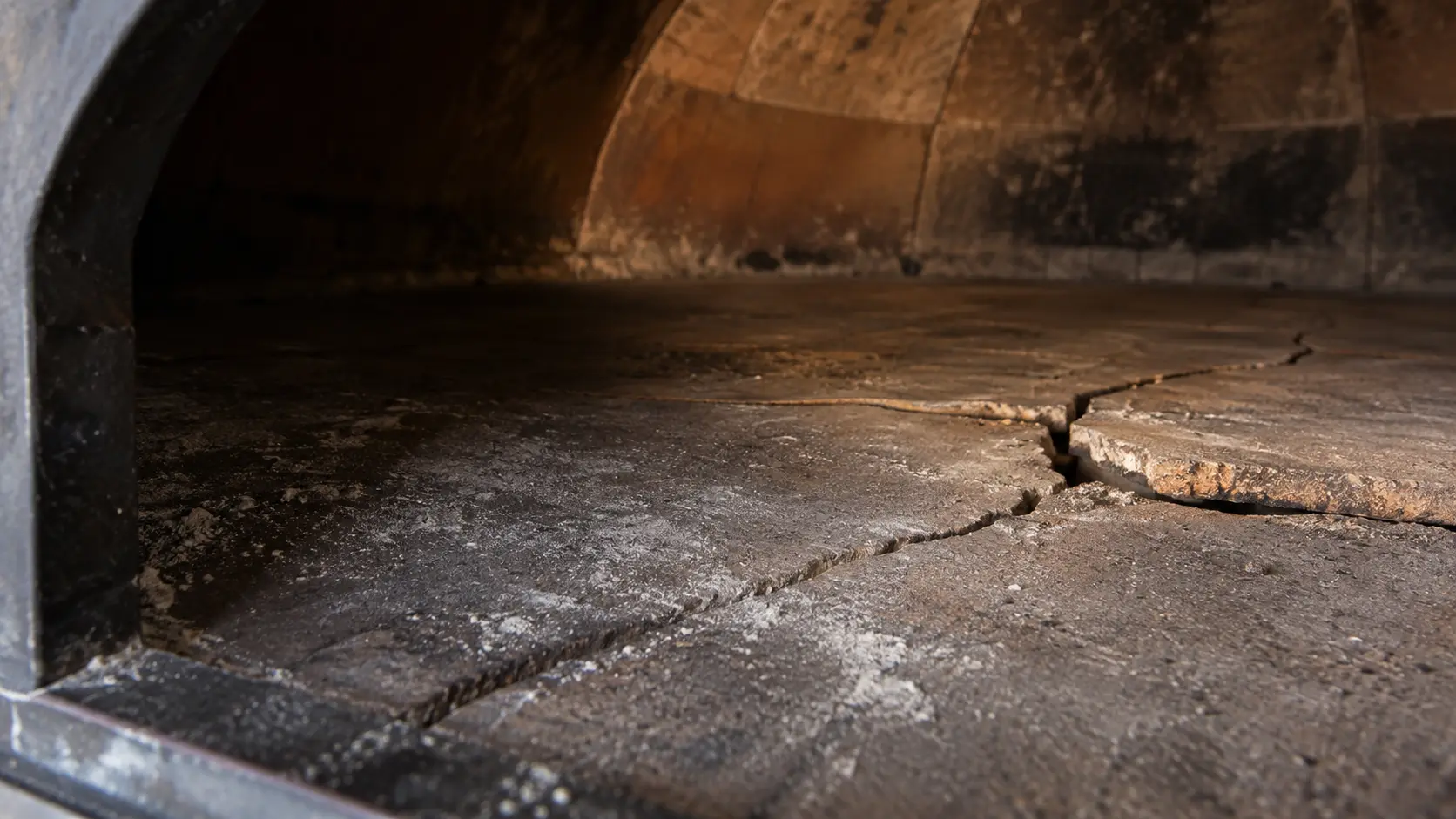
The inner shell of a dome is a ceramic or firebrick that grows when hot and shrinks when cool, and it relieves that stress by opening fine lines. Wood Stone says small crazing cracks may appear with normal heating and cooling and will not affect performance or durability. Alfa goes further for its home ovens: firebricks can crack without causing any performance issue, and the brittle insulating brick under the floor is often cracked just to fit it through the mouth during assembly.
Metal and masonry also move at different rates. Marra Forni warns that small cracks and separation can show where the metal meets the dome, during curing and in normal use, for exactly that reason. Coyote's limited warranty treats micro veins and minor cracks in refractory brick as characteristics of the material. None of that means a crack can be ignored, only that its existence alone is not the problem.
Measuring and tracking a crack
Wood Stone draws its line at cracks of an eighth of an inch or more, which is roughly the thickness of two stacked coins. Measure with the oven completely cold, mark the ends of the crack with a pencil or a strip of masking tape outside the oven, and photograph it next to a ruler. Check again after the next few firings.
- Hairline, closes up when the oven is hot, ends stay put: normal crazing.
- Wider than about 1/8 inch cold, or growing longer each week: book an evaluation.
- Smoke or glow visible through the outer skin while firing: stop firing.
- Flakes or chips landing on the floor or in food: stop firing.
Source: Wood Stone — Fire Deck Automatic 9660 installation and operation manual — Small crazing cracks are normal; contact the maker for cracks of 1/8 inch or more; ceramic absorbs moisture in shipment, storage and idle periods; slow cold start avoids steam spalling; lowest flame until the floor passes 280°F in 24–36 hours, then 24 more hours; water on the walls is normal; Alfa Forni — User manual, domestic ovens (North America) — Firebricks can crack with no performance issues; insulating brick is often cracked during assembly; avoid excessive fires and rest the door over the mouth with a 1–2 inch gap; Marra Forni — Static oven manual — Small cracks where metal meets the dome from different expansion rates; bricks and mortar hold moisture on arrival; an uncured oven will be damaged; curing takes five days; Coyote — Wood-fired pizza oven owner's manual — Micro veins and minor cracks are intrinsic to refractory; keep the door tightly in the mouth and use a cover when idle; do not overload, set the door near the mouth with a gap
Water in the shell is the usual starting point
Refractory and its insulation are porous. Rain through an uncovered mouth, a split in the outer render or a missing chimney cap soaks into them, and the next hot fire turns that water into steam faster than it can escape. Wood Stone calls the result steam spalling: pieces pushed off the surface, and cracks that open wider than normal crazing ever would. Its manual notes that even a factory-cured oven picks up moisture during shipping, storage and long idle periods.
The cure is dull and effective: keep water out and drive it out slowly when it gets in. Coyote asks owners to keep the door fitted tightly in the mouth whenever the oven is not in use and to use a cover through long idle stretches. After a soaking, Wood Stone's cold start is the model to follow, with a very low flame for a day or more before the heat is raised, and it says water running down the oven walls during that stage is normal.
Bringing a dome back after rain or a long idle spell
Your maker's curing schedule comes first. Where there is none for a restart, the pattern the manuals share looks like this.
- Start with a small fire of kindling and thin splits, or the gas burner on its lowest setting, with the door partly open so steam can leave.
- Hold it there for several hours; if steam or dark damp patches show on the outer skin, keep going at the same level.
- Raise the fire a step at a time over the following firings, not in one evening.
- Only bake at full heat once the outer skin stays dry and no more steam appears at the mouth.
Source: Wood Stone — Fire Deck Automatic 9660 installation and operation manual — Small crazing cracks are normal; contact the maker for cracks of 1/8 inch or more; ceramic absorbs moisture in shipment, storage and idle periods; slow cold start avoids steam spalling; lowest flame until the floor passes 280°F in 24–36 hours, then 24 more hours; water on the walls is normal; Coyote — Wood-fired pizza oven owner's manual — Micro veins and minor cracks are intrinsic to refractory; keep the door tightly in the mouth and use a cover when idle; do not overload, set the door near the mouth with a gap

A new oven fired too hard, too soon
Every masonry oven leaves the factory or the builder with water in its mortar and castable. Marra Forni says its ovens look dry on arrival but still hold some moisture, that an oven which is not cured will be damaged in use, and that its curing process takes five full days. Wood Stone's gas-fired stone-hearth oven runs at its lowest flame until the floor passes 280°F, usually in 24 to 36 hours, then at a slightly higher flame for another day before normal cooking.
Deck ovens have their own version of this. Blodgett asks for the first heat-up of its 1060 to climb to 600°F over four hours in 100°F steps starting at 300°F, to temper its deck shelves, and Bakers Pride pre-dries its baking stones on the pilot alone for an hour and then at a low setting for three more before going higher. Skipping those first days is the most common reason a young oven cracks badly in its first season.
Source: Wood Stone — Fire Deck Automatic 9660 installation and operation manual — Small crazing cracks are normal; contact the maker for cracks of 1/8 inch or more; ceramic absorbs moisture in shipment, storage and idle periods; slow cold start avoids steam spalling; lowest flame until the floor passes 280°F in 24–36 hours, then 24 more hours; water on the walls is normal; Marra Forni — Static oven manual — Small cracks where metal meets the dome from different expansion rates; bricks and mortar hold moisture on arrival; an uncured oven will be damaged; curing takes five days; Blodgett — 1060 gas deck oven installation, operation, maintenance — Initial preheat to 600°F over four hours in 100°F steps from 300°F; do not use water or other liquids on the deck; Bakers Pride — Y600/Y800 series deck ovens operation manual — Pre-dry baking stones on the pilot for 1 hour, then below 300°F for 3 hours
Fire habits that open cracks
A dome is sized for a fire of a certain size, and flame spilling out of the mouth is the clearest sign it has been overfed. Alfa says to avoid excessive fires and to calm flames reaching out of the mouth or chimney cap by resting the door over the mouth with a gap of one to two inches; Coyote gives the same answer and adds only as many logs as are needed to hold temperature. Repeated overfiring stresses the shell far more than the occasional pizza night ever will.
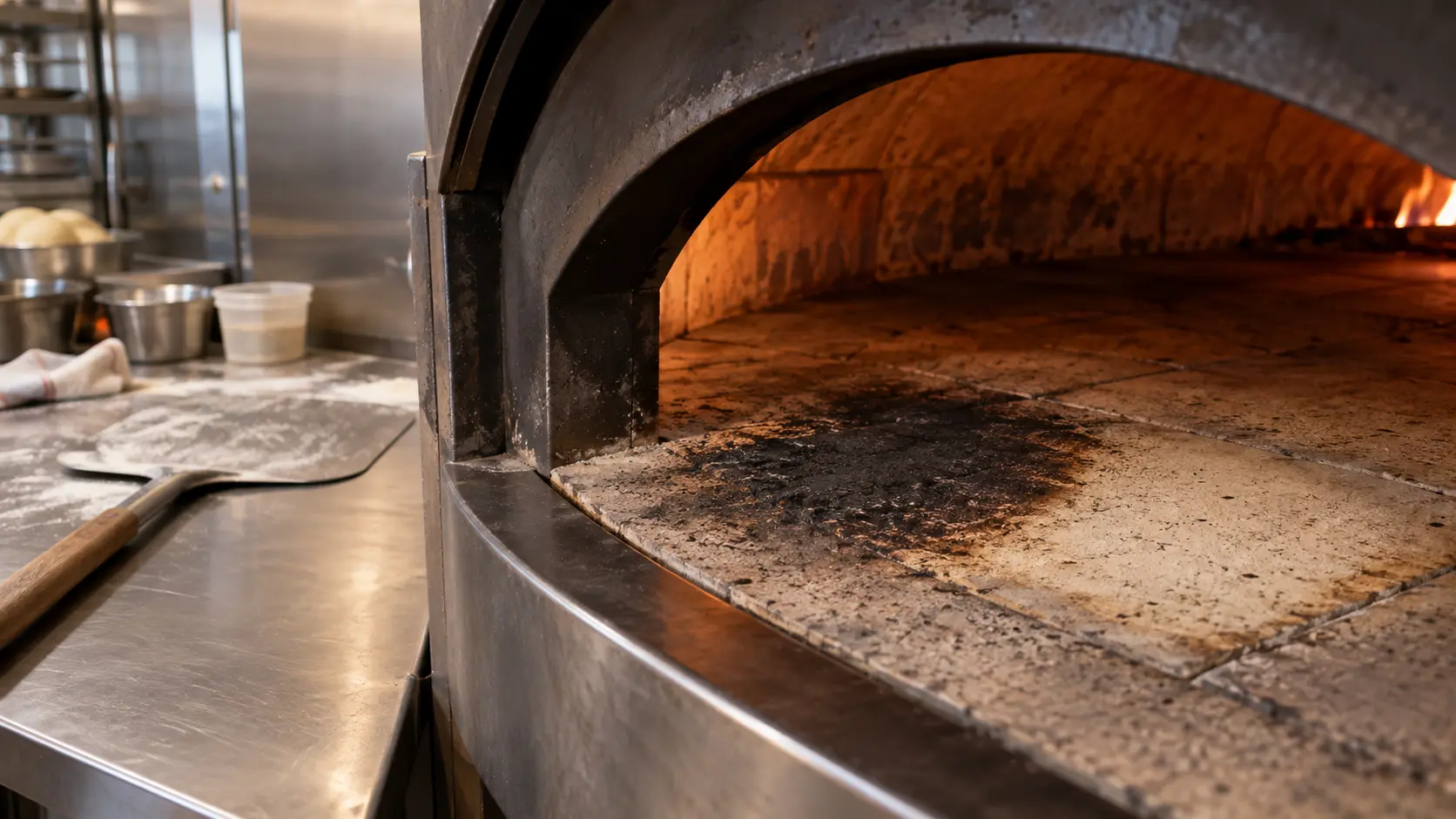
Temperature shock does the rest. Water thrown onto a hot floor, a frozen log dropped onto glowing stone, or a door shut tight over a roaring fire so the heat has nowhere to go all load the refractory unevenly. Blodgett forbids water or any other liquid on its hot decks for the same reason.
Cold things that should never meet hot refractory
- A bucket or hose used to kill a fire; let it burn down with the door set near the mouth instead.
- Wet or snow-covered logs straight from an open pile.
- A wet mop or cloth pressed onto a deck stone the maker says must stay dry.
- Metal trays or cast-iron pans brought straight in from a cold room and set on a hot floor.
Source: Alfa Forni — User manual, domestic ovens (North America) — Firebricks can crack with no performance issues; insulating brick is often cracked during assembly; avoid excessive fires and rest the door over the mouth with a 1–2 inch gap; Coyote — Wood-fired pizza oven owner's manual — Micro veins and minor cracks are intrinsic to refractory; keep the door tightly in the mouth and use a cover when idle; do not overload, set the door near the mouth with a gap; Blodgett — 1060 gas deck oven installation, operation, maintenance — Initial preheat to 600°F over four hours in 100°F steps from 300°F; do not use water or other liquids on the deck
Cracks in the outer skin, the flue collar and the stand
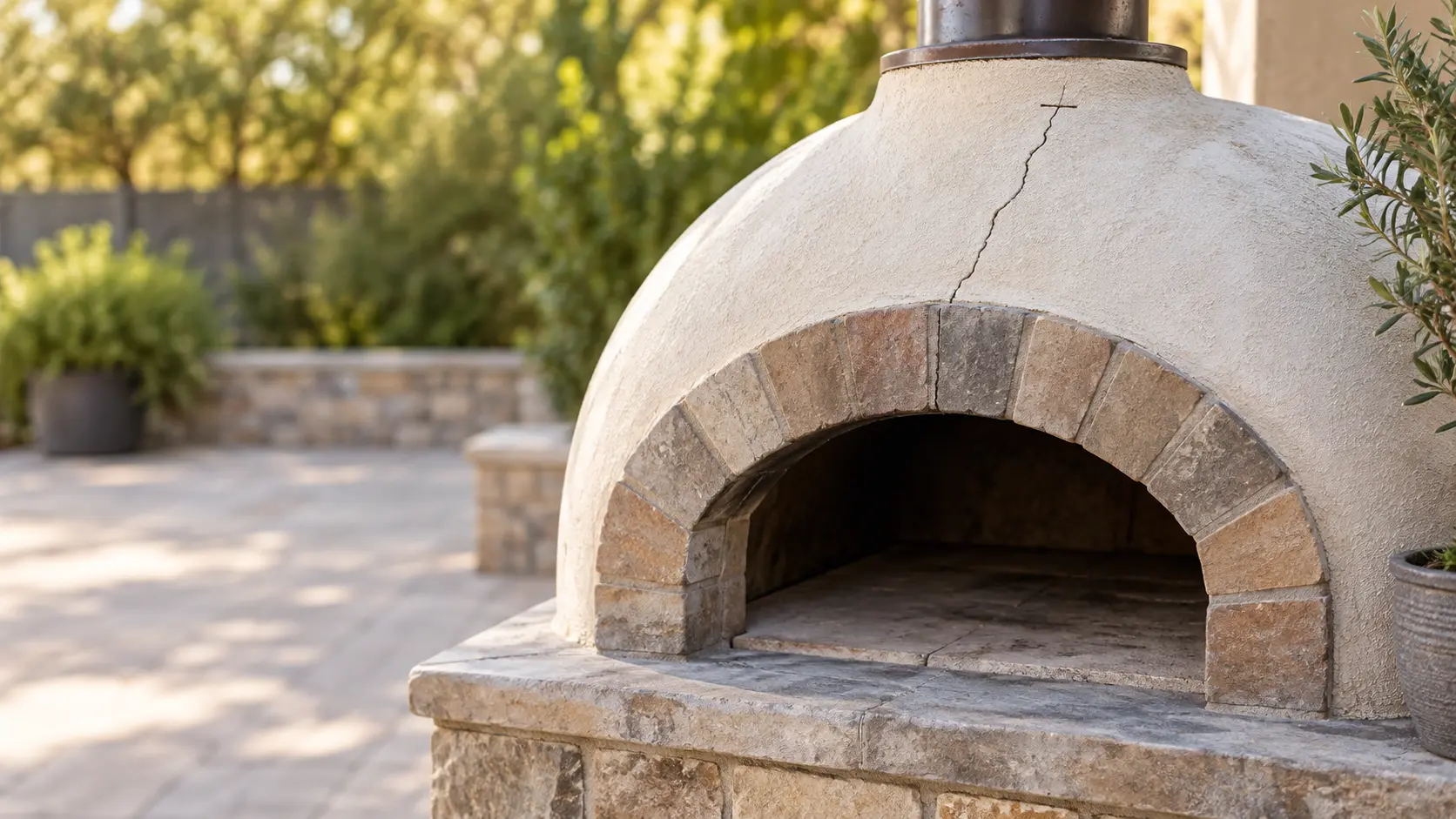
Outside the refractory sits insulation and then a weather skin of render, stucco, tile or steel. A crack there matters more than a hairline inside, because it lets rain into the insulation and starts the steam cycle over again. Cracks that run from the base upward, or that line up with a joint in the stand or the slab, can mean the support underneath has settled, and that is a masonry question before it is an oven one.
Look closely where the chimney or flue collar leaves the dome. Heat and movement concentrate there, and a gap that lets smoke out beside the pipe during firing is not something to patch from a ladder.
When smoke comes through the dome
Smoke or a glow leaking through the outer skin means the shell is no longer sealed, and hot gas can reach the insulation, the stand or a nearby wall. Let the fire burn out with the door set near the mouth, keep people back, and do not fire the pizza oven again until it has been inspected.