
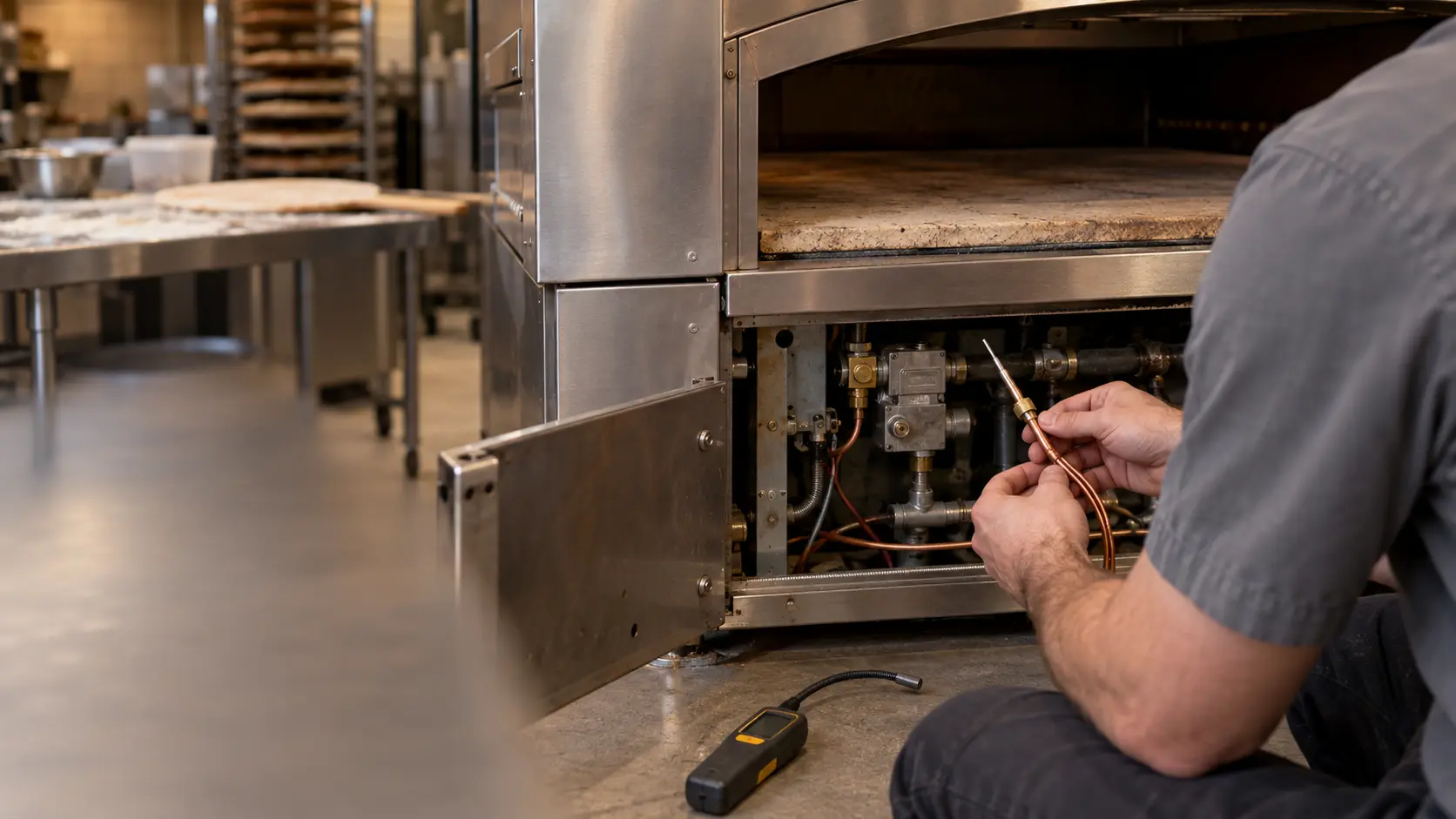
The rating plate decides what the building must supply
Every gas and electric pizzeria oven carries a plate listing its gas type, pressure, burner input, voltage, phase and current. Blodgett says to check the rating plate before making any utility connection so the oven's specifications match the gas and electrical services supplied, and on its 1060 deck oven the plate sits inside the control compartment behind the pull-out panel. Middleby Marshall says electric supply connections must agree with the data on the serial plate, and Bakers Pride builds each oven for the gas named on its plate.
Photograph the plate before the oven goes in and send the picture to the gas fitter, the electrician and the hood contractor. It is also the first thing a technician asks for when an oven will not heat or keeps tripping, and the reason a used oven bought at auction may need more than a hookup.
Source: Blodgett — 1060 Gas Deck Oven installation, operation and maintenance manual — Check the rating plate against gas and electrical services; manifold 3.5 in W.C. natural and 10 in W.C. propane; gas off and disconnected before removing the restraint; installation adjustments by qualified personnel; initial preheat to 600°F over four hours from 300°F in 100°F steps; Bakers Pride — Floor model gas deck oven operation manual — Regulator at 3.5 in W.C. natural and 10 in propane; not on a line with high intermittent-demand equipment; 1/2 in pipe for propane, 3/4 in for natural gas; separate accessible shutoff per oven; flexible connector, quick disconnect and restraint; leak test without flame; Massachusetts gas fitters; Middleby Marshall — PS638 Series Owner's Operating and Installation Manual — Supply must agree with the serial plate; 208/240 V three-phase four-wire; fused disconnect or breaker with lockout per cavity; copper conductors and a dedicated ground, never conduit; post-service leak, combustion, air and ventilation checks; customer arranges connections before start-up
What a gas deck oven or conveyor oven asks of the gas line
Gas ovens are set up for one gas and one pressure. The regulator in the combination valve on a Bakers Pride deck is adjusted for 3.5 inches water column on natural gas and preset for 10 inches on propane, and Blodgett lists the same manifold pressures for the 1060. The supply has to hold that pressure with every burner on the line firing, which is why Bakers Pride warns against sharing the oven's line with space heaters, boilers or other gas equipment that draws heavily off and on.
Bakers Pride also sets out the piping the gas fitter provides: at least half-inch pipe for propane and three-quarter-inch pipe for natural gas, joint compound resistant to propane, and a separate shutoff valve for each oven, as close as possible to where the line enters the oven and easy to reach. Two stacked ovens need two valves.
- Gas type on the plate matches the gas in the building
- An accessible manual shutoff for each oven
- Pipe sized for the oven's input and the length of the run
- The oven isolated or disconnected during pressure tests of the building's piping
- A leak test with soapy water or a leak-detection product, never a flame
Casters, flexible connectors and the restraint cable
Ovens on casters are joined to the gas line with a flexible connector and a quick disconnect built to their own ANSI standards, and Bakers Pride requires a separate restraint so the oven's movement never pulls on the connector. Blodgett says the gas must be turned off and disconnected before the restraint is removed to roll the oven out, and the restraint reconnected once the oven is back in place. That sequence is for the service technician; staff should not roll an oven out to sweep behind it.
Switching between natural gas and propane
Middleby Marshall directs owners to its service network to install, maintain and, if needed, convert its ovens for other gases. After any conversion, readjustment or service, its manual lists four checks: a gas leak test, a combustion and gas supply test, a test of the air supply to the burner, and a check that the ventilation system is running.
Source: Blodgett — 1060 Gas Deck Oven installation, operation and maintenance manual — Check the rating plate against gas and electrical services; manifold 3.5 in W.C. natural and 10 in W.C. propane; gas off and disconnected before removing the restraint; installation adjustments by qualified personnel; initial preheat to 600°F over four hours from 300°F in 100°F steps; Bakers Pride — Floor model gas deck oven operation manual — Regulator at 3.5 in W.C. natural and 10 in propane; not on a line with high intermittent-demand equipment; 1/2 in pipe for propane, 3/4 in for natural gas; separate accessible shutoff per oven; flexible connector, quick disconnect and restraint; leak test without flame; Massachusetts gas fitters

The circuit behind an electric deck oven or conveyor oven
Electric pizzeria ovens draw heavily and usually need three-phase power. Middleby Marshall's PS638 electric conveyor runs on 208 or 240 volts, three-phase, four-wire in its domestic versions, with the amperage for each cavity stated on the plate. The customer supplies a fused disconnect switch or main circuit breaker for each oven cavity, ideally one that can be locked out and tagged, so a stacked double oven needs two separate service connections.
The conductors must be copper and sized to the plate, and the oven needs its own ground wire to the ground screw; Middleby Marshall says never to use conduit or other piping as the ground. Every maker in this guide calls for grounding under local codes or, where none apply, the National Electrical Code, NFPA 70.
Gas ovens need power too
A gas conveyor still runs blowers, a belt motor and a control board, and many gas decks use electric ignition or controls. Middleby Marshall's gas PS638 lists its own voltage and current for the blowers and controls, and Marra Forni advises against plugging its gas domes into a GFCI-protected 125-volt, 15- or 20-amp receptacle, because the electronic burner ignition is prone to nuisance tripping and failed lighting. The receptacle matters as much as the gas line.
Source: Middleby Marshall — PS638 Series Owner's Operating and Installation Manual — Supply must agree with the serial plate; 208/240 V three-phase four-wire; fused disconnect or breaker with lockout per cavity; copper conductors and a dedicated ground, never conduit; post-service leak, combustion, air and ventilation checks; customer arranges connections before start-up; Marra Forni — Static oven manual (Rev. 5-2026) — Grounding per NFPA 70; a GFCI 125-volt, 15- or 20-amp receptacle is not recommended because electronic ignition is prone to nuisance tripping
Start-up day: what gets tested before the first pie
Blodgett says no installation is complete without inspection and, where needed, adjustment by qualified installation or service personnel, and treats these as installation work rather than defects: thermostat calibration, door adjustment, burner adjustment, leveling, gas pressure testing and tightening fasteners. Middleby Marshall notes that the ventilation, electric and gas connections are usually arranged by the customer, after which the maker's installer performs the first start-up.
New stone decks need breaking in. Blodgett asks for the first preheat to reach 600°F over four hours, starting at 300°F and rising 100°F at a time, to temper its deck stones and burn off oil and fiberglass residue.
- Gas pressure measured at the manifold with the oven firing
- Every joint leak-tested after connection
- Burner flame and combustion checked
- Hood running and air supply to the burners confirmed
- Decks leveled and thermostats checked against a thermometer
Source: Blodgett — 1060 Gas Deck Oven installation, operation and maintenance manual — Check the rating plate against gas and electrical services; manifold 3.5 in W.C. natural and 10 in W.C. propane; gas off and disconnected before removing the restraint; installation adjustments by qualified personnel; initial preheat to 600°F over four hours from 300°F in 100°F steps; Middleby Marshall — PS638 Series Owner's Operating and Installation Manual — Supply must agree with the serial plate; 208/240 V three-phase four-wire; fused disconnect or breaker with lockout per cavity; copper conductors and a dedicated ground, never conduit; post-service leak, combustion, air and ventilation checks; customer arranges connections before start-up
Who handles which part of the hookup
The gas line, valves and connector belong to a gas fitter or plumber working under local codes and the National Fuel Gas Code, ANSI Z223.1; Bakers Pride notes that in Massachusetts gas products must be connected by a plumber or gas fitter holding that state's license. The circuit, disconnect and grounding belong to an electrician. The hood, duct, makeup air and any interlock belong to a ventilation contractor working to NFPA 96. Burner setup, calibration and start-up belong to the oven's service technician.
The owner's part is organizational and matters just as much: keep the plate photo and the manuals together, post the gas supplier's instructions for a gas smell where staff can see them, make sure the closing crew knows where each shutoff and disconnect is, and keep the area around the oven clear of boxes, paper and cleaning solvents.
Source: Blodgett — 1060 Gas Deck Oven installation, operation and maintenance manual — Check the rating plate against gas and electrical services; manifold 3.5 in W.C. natural and 10 in W.C. propane; gas off and disconnected before removing the restraint; installation adjustments by qualified personnel; initial preheat to 600°F over four hours from 300°F in 100°F steps; Bakers Pride — Floor model gas deck oven operation manual — Regulator at 3.5 in W.C. natural and 10 in propane; not on a line with high intermittent-demand equipment; 1/2 in pipe for propane, 3/4 in for natural gas; separate accessible shutoff per oven; flexible connector, quick disconnect and restraint; leak test without flame; Massachusetts gas fitters; NFPA 96 — Standard for Ventilation Control and Fire Protection of Commercial Cooking Operations — Fire safety requirements for commercial cooking ventilation