
What a pizza oven gas smell usually means
Natural gas and propane reach the oven through a chain of parts: the tank valve or the building's shutoff, a regulator, a hose or hard line, the fittings at the back of the oven, and the valves behind the knobs. Kalamazoo's guide for its Artisan Fire oven says that when you smell gas there is likely a problem with the installation, and that a connection that is not perfectly sealed can leak just enough for a faint smell while the burners still light and bake normally.
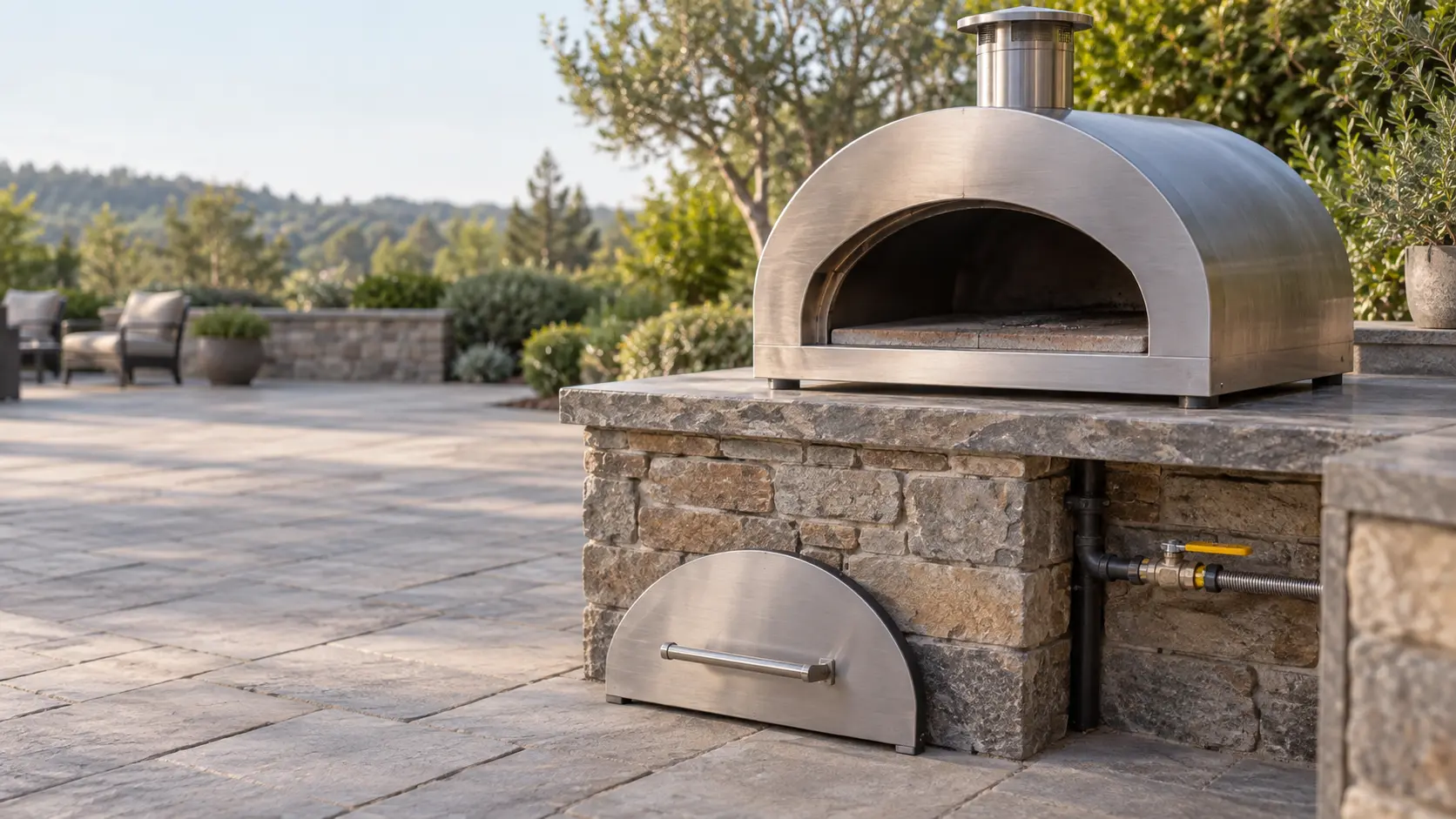
That is why a working oven proves nothing. A smell around the hose on a countertop model, around the cabinet door of a built-in, or along the line that feeds a pizzeria's deck oven deserves the same response whether the flame looks healthy or not. Alfresco's troubleshooting section is blunt: if you smell gas while the oven is operating, turn off all burners immediately.
A puff after a failed light, and an odor that lingers
One brief whiff right after a burner failed to catch is gas that flowed without burning. Kalamazoo's lighting procedure covers exactly that moment: if the burner does not light within about 5 seconds, turn the knob off and wait 5 minutes for the gas to clear before trying again. A smell that is still there after that wait, that returns with the knobs off, or that you notice before anything was lit is a leak until a technician shows otherwise.
Source: Alfresco — Pizza Oven Care and Use Manual (AXE-PZA) — If you smell gas: shut off gas, extinguish open flame, open lid, keep away and call the gas supplier or fire department; turn off all burners if gas is smelled while operating; never leak test with an open flame; do not store an unconnected LP cylinder near the appliance; Kalamazoo — Artisan Fire Pizza Oven Use and Care Guide (North America) — A gas smell likely means an installation problem; wait 5 minutes after a failed light; installer-supplied shutoff valve 3 to 20 feet from the oven; do not use the oven if gas odor is present; LP and NG orifices differ and conversions are done by a qualified technician; never store an LP cylinder indoors
The first minute at an outdoor gas or hybrid pizza oven
The makers print nearly the same four lines on the first pages of their manuals. Alfresco's version reads: shut off gas to the appliance, extinguish any open flame, open the lid, and if the odor continues keep away from the appliance and call your gas supplier or fire department. Kalamazoo swaps the lid for the front door, Coyote's hybrid manual says to turn off the gas supply, put out any flames, open or remove the door and have a gas professional leak-test the connections, and Alfa's North American manual ends its list by sending you to a gas professional.
On a portable propane setup the shutoff is the handwheel on top of the cylinder, turned clockwise. On a permanent natural gas or bulk propane line, Kalamazoo requires an installer-supplied shutoff valve on that line, easy to reach and between 3 and 20 feet from the oven, so it can be closed without leaning over a hot unit. Close it only if you can get to it without going through the smell or past an open flame.
Why the door comes off
A pizza oven's chamber is a small, nearly closed box, and gas that seeps in from a burner valve can pool there. Opening or lifting away the door lets that gas thin out into open air instead of waiting for the next spark from the igniter. Use a mitt if the oven has been running, set the door on the ground away from your feet, and step back.
Source: Alfresco — Pizza Oven Care and Use Manual (AXE-PZA) — If you smell gas: shut off gas, extinguish open flame, open lid, keep away and call the gas supplier or fire department; turn off all burners if gas is smelled while operating; never leak test with an open flame; do not store an unconnected LP cylinder near the appliance; Kalamazoo — Artisan Fire Pizza Oven Use and Care Guide (North America) — A gas smell likely means an installation problem; wait 5 minutes after a failed light; installer-supplied shutoff valve 3 to 20 feet from the oven; do not use the oven if gas odor is present; LP and NG orifices differ and conversions are done by a qualified technician; never store an LP cylinder indoors; Coyote — Hybrid Multi-fuel Outdoor Pizza Oven Manual — If you smell gas, turn off the gas supply, extinguish any flames, open or remove the oven door and contact a gas professional to leak-test the connections; Alfa Forni — User manual, domestic ovens (North America) — If you smell gas: turn the gas off, put out any fire, open the oven door and consult a gas professional
A gas smell at a deck oven or conveyor oven indoors
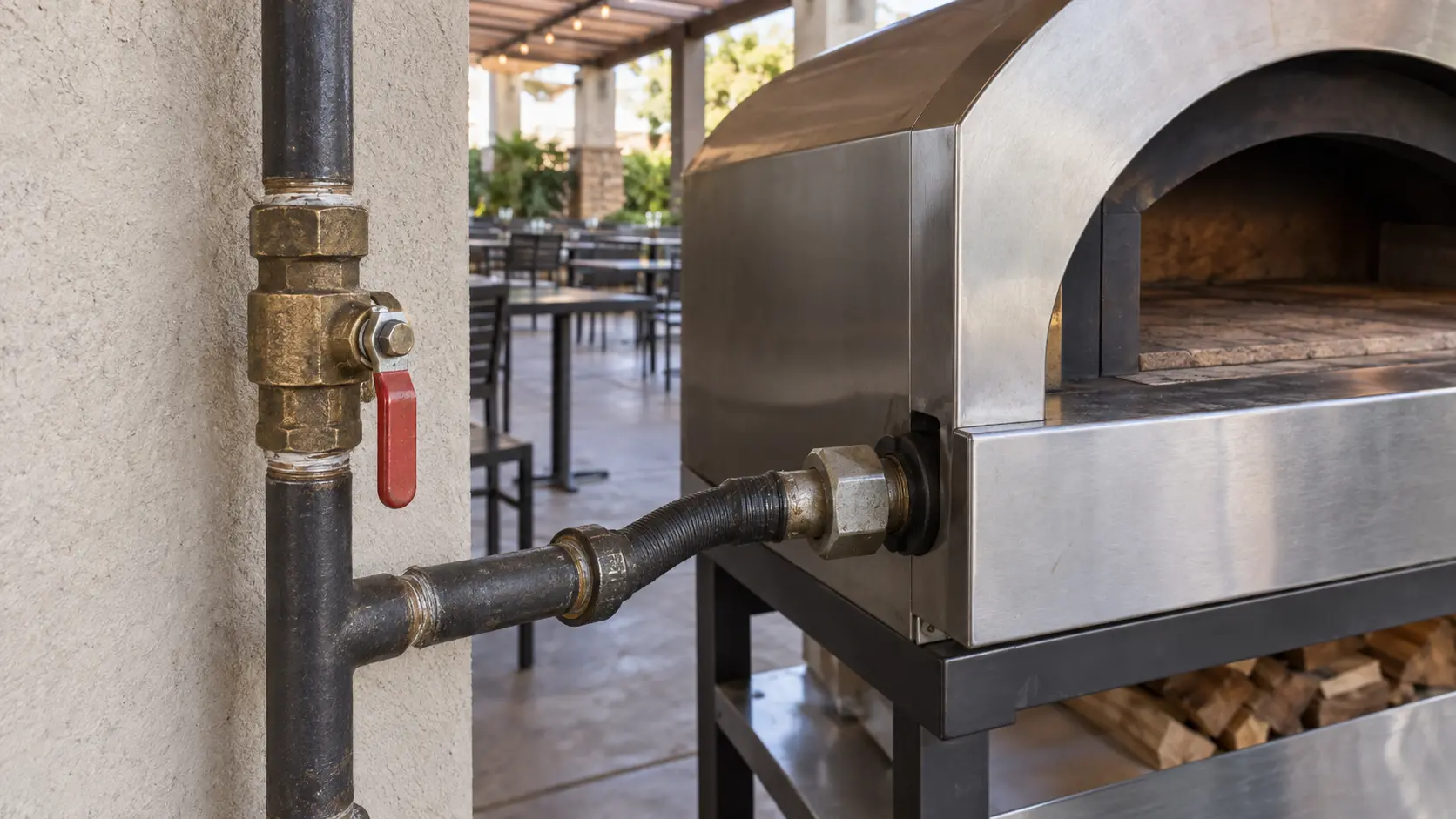
Indoors the rules tighten, because gas can build up in a room and a single spark can light it. Blodgett's manual for its 1060 gas deck oven lists what to do: do not try to light any appliance, do not touch any electrical switches, use a phone outside the building to call the gas supplier, and call the fire department if the supplier cannot be reached. Middleby Marshall's conveyor manual tells operators to call the gas company's emergency number as soon as the smell is detected.
Both Bakers Pride and Middleby Marshall also require that instructions for a gas smell, obtained from the local gas supplier, be posted in a prominent place in the kitchen area. If that sheet is missing, ask your supplier for it now and tape it where the closing shift will see it.
- Stop lighting anything, including the oven's pilot and any other gas equipment on the line.
- Leave light switches, the hood switch and the oven's power switch exactly as they are.
- Get staff and customers out and away from the doors.
- Call the gas utility's emergency line or 911 from outside.
- Wait outside until the utility or fire crew says the building is safe.
Source: Blodgett — 1060 Gas Deck Oven installation, operation and maintenance manual — If you smell gas: do not light any appliance, do not touch electrical switches, call the gas supplier from an exterior phone, call the fire department if the supplier cannot be reached; do not use tools to turn off the gas control; Bakers Pride — Floor model gas deck oven operation manual — Gas-smell instructions from the local gas supplier must be posted in the kitchen area; never check for leaks with matches, candles or flames; Middleby Marshall — PS638 Series Owner's Operating and Installation Manual — Post the gas supplier's emergency number and gas-smell instructions; if gas is smelled, call the gas company's emergency number
Habits that turn a small leak into a big one
Every manual that covers leak testing forbids the same shortcut. Alfresco and Kalamazoo say never to use an open flame to look for leaks, and Bakers Pride calls matches, candles and flames extremely dangerous for the job. Blodgett adds that if a gas control cannot be turned off by hand, nobody should force it with tools; that is a call for a service technician. Alfresco warns against keeping gasoline or other flammable liquids near the oven and against storing a spare propane cylinder near this or any other appliance.
- Lighting a match or lighter near the hose, valve or regulator
- Relighting the burners to see whether the smell goes away
- Loosening or tightening fittings to find the one that hisses
- Parking a spare cylinder inside the island or the kitchen
- Leaving a dented or rusty propane tank in service
The soapy-water check belongs to the technician
The makers describe a leak test done with a mix of liquid dish soap and water brushed onto each connection, with bubbles marking the leak. It is a routine step for the person who installs or services the oven, and Kalamazoo says that if valves or internal connections need checking, a qualified technician should do it. When a smell has already sent you to the shutoff, leave the fittings closed up and let that person find the leak with the right tools.
Source: Alfresco — Pizza Oven Care and Use Manual (AXE-PZA) — If you smell gas: shut off gas, extinguish open flame, open lid, keep away and call the gas supplier or fire department; turn off all burners if gas is smelled while operating; never leak test with an open flame; do not store an unconnected LP cylinder near the appliance; Blodgett — 1060 Gas Deck Oven installation, operation and maintenance manual — If you smell gas: do not light any appliance, do not touch electrical switches, call the gas supplier from an exterior phone, call the fire department if the supplier cannot be reached; do not use tools to turn off the gas control; Bakers Pride — Floor model gas deck oven operation manual — Gas-smell instructions from the local gas supplier must be posted in the kitchen area; never check for leaks with matches, candles or flames
Before the pizza oven is lit again
Kalamazoo says not to use the oven if the odor of gas is present at any time, and the other makers agree in their own words. The next light happens after someone has found the source, repaired it and tested every joint, not after the smell fades on its own. Wind can carry an outdoor leak away for an hour and bring it back when the air goes still.
The visit is also a chance to confirm the oven is burning the gas it was built for. Kalamazoo notes that ovens set for propane and for natural gas use different orifices, that burning one gas through the other's orifices is not safe, and that a conversion kit must be installed by a qualified technician. If the oven was ever moved from a tank to a house line, mention it when you book.
Where propane cylinders belong
Kalamazoo says a propane cylinder must never be stored indoors, in a garage or in any other enclosed area, and that the oven may only come inside once the cylinder has been disconnected and taken out of it. Alfresco adds that a cylinder not connected for use should not sit near the oven, and that a built-in enclosure holding a tank needs vent openings of its own.
Source: Kalamazoo — Artisan Fire Pizza Oven Use and Care Guide (North America) — A gas smell likely means an installation problem; wait 5 minutes after a failed light; installer-supplied shutoff valve 3 to 20 feet from the oven; do not use the oven if gas odor is present; LP and NG orifices differ and conversions are done by a qualified technician; never store an LP cylinder indoors